A good friend ordered a new Model S in 2015. It arrived with a "squeak" that turned out to be due to missing welds in structural components of the chassis. They wanted him to sign an NDA to get a replacement vehicle (which he refused to do, both on principle, and because he'd talked to friends about it already). So he was forced to keep his vehicle, which was then repaired under warranty for what they initially said was not a warrantable defect. To quote him "They took a huge proponent and turned them into someone who will never, ever, recommend them"
And this is how they treated their early adopters that were paying $100K in 2015 for their higher end cars.
I had a few very smart friends who were very successful in business at a young age. They all sort of celebrated having made it by buying high-end Audi’s when they were the hot luxury cars in the mid-2000’s.
The cars weren’t very reliable (even dumb shit like the electric windows would break) and the repairs were notably more expensive than they should have been. One of them explained that he finally understood that someone willing to pay triple the price of a standard car can be charged triple for repairs too.
He sold the luxury car and bought a Prius and said it was 100x better just because of how reliable it was, and it had the same bells and whistles anyway.
I remember 7-8 years ago taking a trip down HWY35, then dropped down into Portola Valley. 5-10M dollar houses. Lot of them had a Prius sitting in the driveway next way more expensive cars.
I mean, I didn't own the car so I have no idea what "options" a luxury car could have over a standard car with all the extra options included, but he sure seemed to think that the Prius had exactly the same things he enjoyed in the Audi.
Note, we were in Austin where something like leather seats would be a bad idea.
Who's to stop the victim from recording evidence, accepting the replacement car, and submitting said evidence anonymously to the media and / or consumer protection and / or the car safety institutions?
It would be a weird play for anyone to sign such a thing. Most states in the U.S. have lemon laws that prevent maufacturers from selling such vehicles. A manufacturer only gets a certain number of attempts at repairs (usually 3 for new cars) on new vehicles or a limited time frame to fix them before they must offer a full replacement.
> A manufacturer only gets a certain number of attempts at repairs (usually 3 for new cars) on new vehicles or a limited time frame to fix them before they must offer a full replacement
Wow that would be awesome. Someone I know here in the EU had a leaking sun roof on their Toyota and after so many fixes and replacements that did nothing (and she had to pay for) the dealer basically said "we can't fix it, the parts are made by another company bla bla ...".
> the dealer basically said "we can't fix it, the parts are made by another company bla bla ...".
If that was a new car recently bought from that dealer, that’s their problem. In the EU (for sales to consumers), it’s the seller that’s responsible for delivering a product that’s fit for purpose. This dealer can’t hide behind the manufacturer or its suppliers (https://europa.eu/youreurope/citizens/consumers/shopping/gua...)
If the car wasn’t bought there or was older than 2 years, the rules only apply to the repair, not to the entire car. I think that means they would either have to fully repair the roof or give you something that’s at least as good as what you brought in for free (things do get murky there for my understanding of the law)
(of course, all that is in theory. In practice, companies will try to avoid having to do that)
>Wow that would be awesome. Someone I know here in the EU had a leaking sun roof on their Toyota and after so many fixes and replacements that did nothing (and she had to pay for) the dealer basically said "we can't fix it, the parts are made by another company bla bla
I never heard of a US lemon law equivalent for the EU, but the EU has pretty good general consumer protection. It varies somewhat between countries, but here in Poland if you buy a new item, if it breaks, it gets repaired under warranty and then it breaks again (it doesn't have to be the same component) the consumer has a choice of asking for a replacement, lowering of the price, or even withdrawing from the purchase altogether. Most people are not aware of this and are getting strung along by unscrupulous sellers. I myself had a situation like this with an induction hob that broke 6 times during the warranty. They then replaced it for a new one and that too broke a month later. I didn't even call them, I threw the damn thing out and I bought a different brand. It has been 3 years and that one has been working fine. Had I known I can withdraw from the purchase back then I'd definitely do it.
We don't have lemon laws in Canada either, I had a major problem with my brand new truck and the manufacturer and dealer were useless, strung me along and refused to help. I ended up giving up and trading it in and buying something else (obviously another brand), it wasn't worth the fight.
Some dealers offer third-party accessories as options on new cars. I had a car whose aftermarket sunroof was installed by the dealer when it was bought by the original owner. Fortunately, mine never leaked, but I'm not sure the US Lemon Laws would have covered it if it had.
When buying in the EU (at least where I'm from) the contract is between the consumer and the seller. So if something is wrong the seller can't shift blame to the manufacturer and have me have to deal with them. How they handle the issue with the manufacturer is their problem. If they can't offer a repair or replacement they need to refund. Manufacturers can offer additional warranty on top of the legally required warranty the seller has to offer which will fall outside of the sellers responsibility.
Companies do sometimes make it difficult in a way I hope more of them get slapped one. The largest electronics retailer in my country will have their front line staff try their hardest to deflect you to the manufacturer warranty, their online return form will make you enter a manufacturer ticket number as a mandatory field, so to actually get that honoured, your best bet is usually to go in store and escalate to a manager.
Normally I try to support stores over Amazon in a "use it or lose it" sense but that particular retailer is the exception.
Yeah not so sure about that. States will have different laws, and NDAs are not Non-Competes -- different story altogether.
Most states can't / won't enforce Non-Competes, but NDAs often have teeth.
Most states also have warranty and lemon laws, often specifically aimed at cars, so you could fight the NDA or ignore it and push for a warranty violation or lemon law case.
That doesn't mean NDAs are unenforceable. It just means you're getting them to fix the problem without signing their NDA, and presumably going through more hassle in the process.
It's pretty painful to drop thousands on lawyers when you know they have significantly more money and better lawyers
I say this as a person who very much wanted to sue Tesla and backed down on the advice of my lawyer friend -- I was most likely only increasing my net loss and severely stressing myself out
This is exactly why NDA's are enforceable. If you sign one, you can not break it without risking litigation. In Tesla's case, they totally would. You can't share any information that is called out in the NDA. This would probably include video, recordings, messages, media, any and all online posts referring to the incident and future discussions of the incident. Whatever is specifically called out in the NDA as far as terms, timeframe, etc. There are some NDA's that are for life.
Teslas are being called MAGAmobiles now that Musk bought Twitter and has shown his love for rightwing disinformation and keeps replying to and platforming alt-right racists and other neo-nazi adjacent folks.
I have this theory that Musk is just playing a long con and deep fake on all of us. He wasn't selling his cars to the likes of MAGA, so he jumped ship and switched sides to make Teslas look cool to the red consumers. The timing of the Cybertruck somewhat coincides with this flip.
So now, Teslas are cool according to those right fringe folks. Of course, the blue side consumers are not super excited about Tesla anymore, but they are already "stuck" with their models (in general). And the red consumers are a bit more likely (maybe?) to follow a fad.
Eventually, Musk will level out and Tesla Motors will just be a mediocre line of vehicles without too much political pop culture. But for now, he's basically playing with everyone to sway various opinions of himself and his companies (e.g. stroking his ego along the way).
Nah most of the world doesn’t see themselves as red or blue and just wants an electric car. People who see everything through the lens of a party and a 2 party system are suckers.
I know a guy with a tesla who is most decidedly on the red side of the political spectrum. He had that tesla from before musk turned into his current evolution and my guy currently wants to get rid of his tesla.
Build quality issues or something.
Your friend was a fool to not take the new vehicle (removing his financial burden) and then just do whatever he wanted with the info...
Granted, I'd lease a Hyundai before ever considering buying a Tesla. It's too bad bc I like the tech, but lack of ownership, software telemetry and shoddy service is a deal breaker.
Yeah shoddy service that is. A colleague has model S, in Switzerland, when going for some service checks they kept him there, in the middle of nowhere without any good public transport for half a day without any warning during work day, he was furious.
Every single crappy dealer/official service here will give you a replacement car to not mess up your life for just stupid car checks, whatever basic car is fine. Tesla no, fuck off we don't care, wait.
> The Tesla Files episode revealed that the BEV maker instructs its technicians always to provide feedback orally. Internal documents obtained by Handelsblatt stated: "Do not copy the report below into an email, text message, or leave it in a voicemail to the customer."
I don't know how serious a crack in the front casting on a Tesla is, but this kind of policy is pretty egregious.
That kind of policy should mean that in any court case where a customer's version of events/conversations differs from Tesla's, the customer is assumed to be telling the truth until definitely proven otherwise. The legal liability of this policy should be so great that no sane company would have this policy over just creating a paper trail in the first place.
if electronically stored information that should have been preserved in the anticipation or conduct of litigation is lost because a party fails to take reasonable steps to preserve it, and it cannot be restored or replaced through additional discovery, the court only upon finding that the party acted with the intent to deprive another party of the information to use in the litigation may presume that the lost information was unfavorable to the party.
In previous employment (as a software engineer), I've been told to do this too - mainly around inventions we were trying to patent. The reason is slightly less nefarious than you might think - for example, someone might casually say that some aspect of their patent is "obvious" but they're saying that as an expert in their field who may have spent months or years thinking about the problem and alternative solutions. However, if it came to court, "even the inventor said this was obvious" is a pretty hard thing to respond to.
To provide my own anecdote, refusing to take any feedback except orally was how the Sacklers instructed their sales reps to handle issues and concerns about Oxycontin abuse. It was to avoid having any discoverable evidence that they received reports of abuse and did nothing about it.
I agree its usually not good to sprinkle legal landmines in your email history, but FWIW the obviousness standard for US patents is someone "skilled in the art", so an expert working in that field finding it obvious is failing the obviousness test.
OK, but you get what parent post is saying. This particular example might have a technical answer but the overall point is that emails tend to lack context and are composed for brevity / convenience.
"If you give me six lines written by the hand of the most honest of men, I will find something in them which will hang him." - Cardinal Richelieu
it sounded like the overall point was that, by avoiding retained communications, they could get away with something they otherwise would not be able to get away with, and should not be able to get away with (patenting something obvious)
what sort of context could be added which exonerates that behavior?
if the context exonerates it, why not have a policy of including context?
if it's somehow benign, but cited out of context, why not just provide the context?
and, if such exonerating context doesn't exist, wouldn't society prefer they not get away with patenting something obvious?
It's a hell of a lot easier to not have to defend a statement made out of context than it is to do so. It's the same reason you should never, ever, under any circumstances answer any questions about anything at all coming from the police without your lawyer. Even if you are completely innocent, your words can be presented in such a manner as to call into question your honesty, at which point your rebuttal will be shrouded by distrust.
The quintessential example is an alibi. If the cops accuse me of shooting someone in SF, but I was in Berkeley at the time, I might be tempted to tell them that. But then, when they produce a faulty eye-witness, who says they saw me in SF that evening, suddenly I need to discredit that witness in order to resolve my alibi. Meanwhile, if I hadn't said anything, the witness's claim that I happened to be in the same city on the same day as the murder is nowhere near enough evidence to cause me any problems.
> If the cops accuse me of shooting someone in SF, but I was in Berkeley at the time, I might be tempted to tell them that. But then, when they produce a faulty eye-witness, who says they saw me in SF that evening, suddenly I need to discredit that witness in order to resolve my alibi.
you have an equal need to disprove the claims of a witness regardless of whether you have an alibi
additionally, regardless of whether there's a witness, all you need to do is prove you were in Berkeley to remove yourself as a suspect
so the two things (alibi, witness) seem orthogonal
You don't, because the witness testimony is irrelevant on its own. Without knowing the alibi, there's no reason to think the OP being in SF is an issue at all.
in the example given, the lawyers finding ways to dismiss/challenge it would be a good thing, because the perpetrators in question are trying to patent something obvious, which society has decided we don't want them doing
so, the problem spurring such a policy is that they don't want to be implicated on the record in doing bad things - they want to get away with what society doesn't want them to get away with
In the actual example, I don't think the engineers were trying to patent something obvious - it's just not unusual for engineers to casually throw around the word "obvious" for things that are not, and it's unwise to have that written down.
in the actual example, from the information given, I think the engineers were indeed trying to patent something obvious to them, or else they wouldn't have explicitly said it was obvious to them (speaking as an engineer)
I guess I need more convincing, 1st that there is indeed full context exonerating the "obvious" quote from meaning what the words mean, and 2nd that it wouldn't work to just provide that context to resolve the matter (e.g. if it truly is exonerating context, why wouldn't providing the context exonerate?)
when I asked for that detail, I just got a snide, uninformed remark about the answer being obvious, from someone who clearly could not come up with an answer
> or else they wouldn't have explicitly said it was obvious to them (speaking as an engineer)
I’m sorry but you might consider patenting your mind reading device.
It seems pretty easy to imagine engineers spending week/months/etc. solving a specific problem the solution to which might seem pretty ‘obvious’ to them when they actually manage to arrive at it. That doesn’t necessarily mean it’s actually obvious ..
> wouldn't work to just provide that context to resolve the matter
Why take the risk? And even if you end up winning at the end having to prove something like that will still result in additional costs and/or delays.
Your reasoning seems to be based on vague assumptions based on a very vaguely described situation. I find it hard to understand how can someone feel so certain about it with close to zero real context.
> Your reasoning seems to be based on vague assumptions based on a very vaguely described situation
indeed, with no detail provided, we're forced to make assumptions, or ask for detail
I chose the latter, that is why I included this in my post:
> I guess I need more convincing, 1st that there is indeed full context exonerating the "obvious" quote from meaning what the words mean, and 2nd that it wouldn't work to just provide that context to resolve the matter (e.g. if it truly is exonerating context, why wouldn't providing the context exonerate?)
when I asked for that detail, I just got a snide, uninformed remark about the answer being obvious, from someone who clearly could not come up with an answer
I would like a response to that part of the post if you feel up to providing it, please
Have you seriously never met an engineer who assumed something was obvious to everyone that was actually only obvious to them? That like, top ten stereotypical engineer behavior.
I agree, and was originally going to downvote the parent comment for the same reason, but then realized I think they were replying to this more general point in the GP's post:
> "Do this only orally" is always to hide evidence from a future court discovery.
That is, I've followed enough court cases and news reports to have seen things taken egregiously out of context to agree there could be valid reasons to limit discoverable communications (though not in Tesla's specific case), especially because so few people seem to argue in good faith anymore. For example, lots of times in long email or slack threads people throw out ideas, even if they're not particularly well thought out, because that's part of what being in an open, healthy organization entails. And then I've seen these communications presented as some sort of official corporate position instead of brainstorming.
What you're describing is still fine because a solid defense is to look at someone taking something out of context and going, "would you mind continuing reading?" where someone else follows up shooting down $controversial_thing because liability etc.
The only reason not to create that record in the first place is because you weren't interested in compliance from the get go, and you were banking on the "naive first violation" defense.
Been there, seen it in action, left because of it. Ethical abandonment, no matter how it is gussied up, is ethical abandonment. There is always time for doing what you should to keep your nose clean.
I think it might have been more about how patent law works. There is a precise window defined for revealing invention to filing for it, same for selling something before patenting it (1 year).
If it is legal where you live, you might want to get in the habit of secretly recording business dealings. I always have a recorder in my pocket when dealing with more than a few hundred dollars.
Be careful of your jurisdiction. In some places, the act itself of secret recording can be a criminal offence. In that case, you will want to include the possibility of prison in your cost-benefit analysis.
In some places, secret recordings are useless as evidence (e.g., two-party consent states in the United States), while in others even illegal recordings may be admissible anyway (e.g., Sweden).
For example, in Germany, a lot of the privacy culture (and therefore, laws) came about because of how the secret police terrorised the common people, for example, using secret recordings and worse (e.g., secret evidence).
But in other places, sure, I would agree with you.
Secret recording may be a criminal offense. I am not a lawyer in any jurisdiction, but it appears to be a felony in parts of the US. Admitting to felonies in court is probably not a good legal strategy. Even if you don't get arrested I am not confident the evidence would be admissible.
EDIT: I know there are places where secret recordings are illegal but don't know the expected penalties. Recordings are probably legal in a "one-party consent" state. Be wary; certain kinds of recording may be illegal even if recording is legal in general.
In a lawsuit, you will be required to hand over all relevant records. It is illegal to destroy them or fail to hand them over. The penalties for doing so could be severe.
But even if you get away with it, hiding evidence would be wrong. Don't respond to sleaze with yet more sleaze. Maybe you'll win the fight or maybe you'll lose it, but you will always lose something of yourself.
Yes. The most aggressive consent requirement for recording is 'two-party' consent, where the both people on the call need to be aware it's being recorded. If you say "this is/may be(ing) recorded" then both parties are aware.
If you tell a company calling that you might also be recording I found they like to end the call fast. Funny how it’s okay if they do it and hold all the evidence…
Yes, in a previous life I did some soul-sucking call center work for a large national mobile company and they specifically had a written policy at the root level of their knowledgeable system about call recording. Their instructions were that if anyone was recording the call you were to read a certain script and immediately disconnect, no questions asked. If they tried to do the 'this call may be recorded' thing you were supposed to seek clarification about whether the call is being recorded and if the answer was anything other than no, you were to read the same script and immediately disconnect.
These companies know that worker bee call center drones say things all the time that the company doesn't want preserved in a court of law later- mainly promises that the company doesn't want to have to uphold if they were outside policy. They take it very seriously. I suspect any major company with something to lose has a similar policy.
Not in Germany. You have to get explicit permission or at least give the chance to deny consent, just because you consent doesn't mean the recording party did. It's a bit sad, IMO.
What I do is I inform and get consent from hotline agents during the call.
"Determining which jurisdiction’s law controls in cases involving recording devices or parties in multiple states can be complex, so it is likely best to adhere to the strictest applicable law when in doubt, and/or get the clear consent of all parties before recording."
So it doesn't seem to be simple to determine what's legal in any given situation.
Staying on the line after being notified the other party is probably going to start recording soon is essentially giving consent. The caller could have just hung up if they didn't want to be recorded.
This looks to me like a "cold shut", which is a type of casting defect.
"Cold shuts occur when two relatively cold streams of molten metal from different gates meet and do not fuse together properly during the casting process. This problem is visible to the naked eye – giving the appearance of a crack separating the two sections."
I think it’s safe to say cracks in a structural member are always bad. I think the point the OP is making is that it looks like a manufacturing defect not the result of a crash.
It seems they have no automated optical inspection (AOI) system. Why? Theories. (1) Manufacturing site footprint availability. AOI on large assemblies with high throughput requirements may be extremely spatially and temporally inefficient as the need to control lighting means a substantial facility footprint may be required. (2) manufacturing operation build time pressures (3) assessments and claims by the casting equipment provider (4) the potential unavailability of an off the shelf solution suitable for parts of this scale.
Stable process control could eliminate the need, but AOI is relatively cheap insurance.
New delivery buyer is digging around under the hood to confirm their brake fluid reservoir cap is in place, as there had been recent reports of missing caps.
Finds the cap is good, but that the cars frame is cracked instead.
This is a slam-dunk for the typical American lemon law.
The owner of the car should go out and find a lemon law lawyer. When I had to work with one I didn't have to pay a thing.
(I had a Subaru where the GPS / Stereo would reboot while I drove and loose its settings. After a bunch of replacements, the car still had the problem. I had to catch it on video, though. Subaru ended up declaring the car a lemon after trying to fix it multiple times.)
FWIW: I own two Teslas and their service is horrible. Every time I take it in, they never put the car back together and I have to take it back.
Genuinely curious; why did you buy the second one? I might possibly be slightly over-vindictive with brands, but once a brand fails me I’m very reluctant to buy something else from them (a Samsung TV with some silly quality control and firmware issues was enough to make me swear off Samsung, and the Nexus 7 (original one; the one that tended to degrade after about a year) was enough to convince me never to buy hardware from Google again, say). In particular, I would never buy the _same thing_ (most current Tesla cars are ~the same thing) from a company where I’d already bought one defective thing.
Ironic fact: The Nexus 7 and the original Tesla Model S share the exact same flaw: They both used a Tegra 3 SOC with memory that would effectively fail in shorter-than-normal time. The outcome is that the system would get slower or in the Tesla's case, crash.
I’m shopping for anything EV other than a Tesla now. There are many options now, but Tesla is still way ahead with the power train. Most competitors aren’t at the same place on range & performance yet.
It’s an amazing power train glued inside a 90s-era Oldsmobile.
I’m very hopeful that in five years time, Tesla has been so thoroughly lapped by the rest of the car industry that they have to start closing some of their gigafactories.
I love my Tesla and I too hope that other automakers get better at producing EVs. Competition is great and the whole world wins when everyone gets better. I'm looking forward to being able to get an electric Audi, Volvo, VW, etc. and be confident that the software, updates, charging infrastructure, etc. is be better than Tesla's system. That day is not today, but I hope it's soon.
The Mach E has a mere 40mi less range (290mi) and slightly better performance than the Model Y. They are also adding support for NACS (Tesla charger port) at some point soon. That's the only comparable EV that I know of at the price point, but there's definitely more.
Ford can't sell Mach Es to save their life, though, because they don't have ludicrous mode/800 HP/name appeal. Massive flop from Ford (and I say that as the biggest ford fanboy in this thread.)
You and I know that the ford is made much better for "less", for obvious reasons
But ask yourself, who is going to buy a heavy electric SUV from Ford?
-a typical mustang GT buyer? No way.
-a person who currently has a model S/Y/3? fat chance.
-a new EV buyer? Too expensive and "bland". Does all EV
things "middle".
-A ford Fan? I'll gladly take the f150 lightning over mustang.
I want to see the f150 lightning and similar really make a dent/impression.
You missed the "I want a get from A to B SUV, without Tesla" - which is squarely me. The type of shit in the article, right to repair, and general Elon bullshit has me very uninterested in Tesla.
> -a new EV buyer? Too expensive and "bland". Does all EV things "middle".
It is actually SUV-sized (unlike the likes of the Kona, which you may be comparing it to - it is only shaped like an SUV). It can be cheaper than the Model Y, depending on the sku - and those two are the only budget EV SUVs that I am aware of (the E-Tron and iX are significantly more expensive).
Bland? Who cares. There are people who only care about the utility that a vehicle has to offer.
It is servicing an area of the market that only has one other deeply incompetent (as-per the article) competitor.
I'm a big fan of my Chevy Bolt. ~250 miles range is plenty for commuting and making day trips to friends and whatnot. Any further than that and I'd want to fly, anyway.
It makes me so happy that Chevy decided to no longer discontinue the Bolt. I’m both poor and currently very happy with my current car (ford cmax). But once this guy’s life is over, I’m looking to a bolt next. Or if Tesla has the rumored Model 2 out by then I’ll consider that as well.
Being "in the market" it wasn't until thr new crop of Hyundai EVs came out that there was anything approaching the Tesla in the car-design feature set. Sure you could buy a Prius, but I always felt like the Prius was designed to be ugly and awkward to drive specifically so it wouldn't hurt Toyotas billions of dollars of ICE sales.
Because I needed a 3-row vehicle, I refuse to buy anything that runs on gasoline, and the Supercharger network is the only viable high speed charging network in the US.
I didn't know the Nexus 7 had issues I had mine for almost 10y and just gave it away to someone it is still working and the battery too (albeit not really long anymore).
You may have had the second iteration. They released a slight upgrade about a year later under the same name, and it wasn't susceptible to the same degradation.
That's just normal flash memory degradation when you are using low quality chips. It's very common, especially among low end Samsungs. It's not something that can be fixed on the software side.
It was really very rapid in the Nexus 7 for me, though. I think my iPad Air 2 has it to an extent now, say, but it’s _9 years old_; it is somewhat understandable. My 2012 Nexus 7 was starting to behave very badly a year in.
Were you doing any rooting, flashing of custom roms, large i/o operations like video stuff or similar? The average flash memory chip quality of that era (depending on the supplier) wasn’t great, they can’t handle as much read-write cycles as typical modern consumer silicon.
I had to go in for a recall on the charging port, and when I came back home the car wouldn't charge because they connected something incorrectly.
When I went back to get the car fixed, they left a bunch of wires disconnected under the back seat.
A few weeks ago I had to go in for a problem with the driver's seat belt. They didn't re-attach the panel with the switches for the power seat correctly, so now it keeps falling off.
Us too! They fixed a door handle and now the interior door panel falls off. They fixed a flash storage issue with the touchscreen and now it leaks some kind of sticky sealant everywhere. I’m scared to have them address anything.
You knew the manufacturer had a reputation of forgetting hard to check parts... and you still bought one.
What else could it be missing that you can't practically check for?
Still I guess at least it's good to see Tesla living up to the reputation for American cars to be generally shit build quality. I feel like they're going a bit overboard on that factor though.
>The electric SUV owner told me he still prefers that I use only his initials and his other nickname (Cracked_Tesla) because he wants to give another Tesla Service Center a chance to do the right thing.
The owner received a car with cracked structural components and is still going to give them another chance. I could understanding asking to remain anonymous to avoid retaliation or public scrutiny, but not whatever this is.
Cracked_Tesla, if you're listening, the correct response is to demand a complete refund or replacement. If refused, take legal action. This could be an ordinary lawsuit in civil court or a complaint filed under the local lemon laws. You are owed tens of thousands of dollars, so hire a lawyer. And then spread the story far and wide, naming the particular Tesla employees involved, because these people tried to kill you.
Unfortunately when people are so emotionally involved with something be it a CEO, a brand or a religious group they will go through all kind of brain gymnastics to not really blame them. Look at the child abuse in the catholic church (and all the others that are just barely starting to be known), their congregants protected the priests too and found all kind of excuses.
This definitely seems like a little Stockholm syndrome. You see it also when it comes to doing a chargeback against a company that defrauded you. Inevitably someone will say "But, if you do a chargeback, the company will close your account and ban you!" These people have gotten to the point where the company has stolen their money, and they still want to continue doing business with them! A lot of simping for companies that don't deserve the affection.
It’s not just simple simping. Those companies have such large operations, with so little competition, that it’s hard to find an alternative.
What if you’re not a tech person at all and you can’t use Google, Amazon, Microsoft, Apple, Facebook, Samsung, eBay. You’re screwed, cause the alternatives might as well be wizardry.
For what it's worth we've wanted to own a Tesla for a long time to own an EV. The overpriced nature and all the terrible things I've read about the build quality continually shied me away from actually spending money or even leasing one.
That is until I just so happened to make a little extra money on TSLA stock by accident. I then turned around and found a salvage title, dirt cheap, home wall-charger included 2018 Model 3 and sold off some that TSLA profit for a free car for my wife. We've owned it long enough to confirm all "the build quality is crap" rumors. I'm a mechanically inclined person and I'm not idiot so I have taken the car apart enough to verify it is safe and it isn't dangerous (salvage title, total loss vehicle) but once you start taking things apart you see the corners they've cut where other car manufacturers do it differently - things like water drainage and body panels alignment is just too easy to spot if you've owned 15 cars over 30 years.
Long story short, I wouldn't buy a new one. I certainly wouldn't spent my _hard earned_ money on one. But I don't mind gambling a bit on a rebuilt title mass-produced one. That's about the level of trust I have in Elon's ability to build a quality automobile.
They are ok cars but everything you've heard about build quality and defects is absolutely true. I've never attempted to use the autopilot because I value my life.
Former colleague of mine was Tesla from day 1. Started an online journal of the life of his car. It's stuff like "well this car is great but this year I spent a huge amount of money because A, B, C broke and wasn't covered under warranty". As time goes on the journal just gets worse & worse. Can't help but laugh and be reminded by the family guy episode where they see a Tesla driving itself while the driver's busy sucking his own dick.
People are weird about nearly all car companies... Tesla hits some other nerves and feels with electricifaction and being a new "American company" but it's the same as most other car companies. There are crappy car companies out there and there are people that will buy their cars.
It's a status/whatever symbol, build quality doesn't really matter. I've a friend that drives a Model 3 and said "it's just like driving a BMW" and of course he has never driven a BMW.
Anyone who has so much as sat in a mid to top tier car from BMW/Mercedes/etc will instantly come away with an overwhelming sense that a Tesla feels cheap by comparison (because it does). Classic things like the sound and feel of closing a door, gripping a steering wheel, pushing a button, etc.
If you pay attention to detail this can often be experienced from the car externally - famous cases of Tesla tending to have poor tolerances and high variability in things like panel gap, etc.
> You knew the manufacturer had a reputation of forgetting hard to check parts... and you still bought one.
Sometimes, you have to make tradeoffs. You may want a Tesla for a variety of reasons, and the reputation for unreliability is not enough to tip the scale for another maker. With that in mind, buying the Tesla and thoroughly checking for known issues may be the most rational thing to do.
>You knew the manufacturer had a reputation of forgetting hard to check parts... and you still bought one.
Yeah but the company is run by a hip cool memelord who's gonna get us to mars, and his cars have nice softwares like my iPad. Who cares about the metal parts of the car's rigidity structure? That's just something old boring people think about. Everyone knows EVs are more reliable than ICE so no need to ever look under the hood. $TSLA to the moon! /s
>Still I guess at least it's good to see Tesla living up to the reputation for American cars to be generally shit build quality.
The shit build quality has less to do with being American, and more to do with Tesla chasing higher margins, high margins which in part come from cutting a lot of corners in places where customers aren't looking for, which in a tracic-comedy way is what most American auto-makers did to get to their shit-build quality reputation.
To be fair, many brands have QA issues all the time, but that one from the article is so big and obvious it should never have made it passed inspection.
> The shit build quality has less to do with being American
I'm not suggesting they're shit because they're American. I'm just saying it's nice to see them living up to the existing standard of shitness set by the existing American manufacturers.
I'm sure each American car manufacturer has their own unique and interesting reasons for having reliably shit build quality compared to European or Japanese manufacturers.
I posted an HN comment [0] a while back that is one example from prior work experience. It shares how specification differences between the domestics and Japanese auto-makers impacts downstream and overall system reliability/quality.
I was hesitant about buying a Chevy Bolt EV for similar reasons, but honestly, zero complaints. Well made, pleasure to drive. They did have a battery recall but that was due to defects introduced at an LG factory in Korea IIRC
Some people love to claim that electric cars will be more reliable due to mechanical simplicity. And yet somehow the highly complex Prius is still far more reliable and durable than any Tesla. It turns out that simplicity doesn't help if your engineers and assembly workers are incompetent and badly managed.
Toyota Prius is one of the simplest currently made ICE cars. There is nothing simpler and more reliable than port injection inline 4 engine and eCVT transmission.
Got a friend working for tesla after-sales service in Europa and he claims the Chinese-made Teslas are better quality than the ones that are American-made
>Chinese-made Teslas are better quality than the ones that are American-made
Shit rolls up-hill. It's not that american factory workers are worse at assembling widgets than chinese factory workers, it's that american factory management is shit.
British Leyland would also traditionally make garbage cars, but when the Japanese came, those same workers were churning out good cars.
Processes, culture, management and leadership makes all the difference.
As the post you’re replying to mentions, this is indeed a thing that US manufacturers did back in the day. It didn’t work out for them, in the long run.
> a thing that US manufacturers did back in the day
Is this...a joke?
We are currently going through inflation caused directly by margin chasing and stock buybacks. If you look into any industry you will see a long race to the bottom to get the most money for the least product imaginable.
It's the #1 function of a capitalist system, to extract the most value for the least work. Margin chasing is all we do. It should be included in our national anthem.
Obviously US automakers want all the margins they can get, but in the past they pursued margins _to the extent of making very low-quality cars_ (then had their lunch eaten by foreign competition; it did not work out well for them at all). They largely don't do that anymore; their quality is more comparable to foreign competition than it used to be.
If this vehicle were truly unsafe to drive (according to US safety standards), what legal recourse would an individual consumer have to have this fixed?
Unless the user gets in an accident, is there a way to actually prove the frame is structurally defective?
Tesla's service center might be willing to say "within spec!" but I suspect they'll have a much harder time finding an engineer willing to put their license on the line in court.
I don't think that is true in the United States. The Federal Arbitration Act applies nationwide, and it explicitly preempts state law.
If you think that I am wrong, please explain why.
(You are right that you "can sue regardless of outcome," but only in the sense that anyone can sue anyone for anything. If you enter into an agreement to arbitrate disputes, the outcome of that arbitration is generally binding.)
Lawyers prove things in court for a living. They wouldn't have any trouble proving the frame being cracked nearly in half is a defect.
It probably wouldn't get to court, though. The government deals with lemons all the time. Every state has ways to get lemon buyers relief quickly and at minimal expense.
Pretty sure the onus is on the manufacturer to produce cars in a repeatable fashion such that crash test samples are representative. If they can't make the cars consistently they shouldn't be making cars.
Ah, more confirmation (bias) making me doubt the wisdom of ever buying a Tesla in the future.
I had a Model 3 LR as a company car and really liked it - even being fine with most of the usual concerns or dislikes people share. I even like the brand (although I dislike most of Musk's other shenanigans over the past few years).
I've since given the car back and am considering purchasing a BEV in the future. I've obviously been considering another Tesla, but my single (small) negative experience with their customer service, plus myriad stories online (including this one) make it a total lottery: you must cross your fingers that your car is perfectly reliable, else be launched into a world of potential frustration and difficulty (not to mention potentially huge cost, if not warrantied) gettings things fixed.
That lottery extends to every other car maker/dealer. Lemon laws existed before Tesla for a reason. Dealerships put a bitter taste in peoples mouths for a reason.
I agree. However, with most other manufacturers there are options beyond the dealerships. In contrast, Tesla is notable for the lack of spare parts available to the public (making DIY repairs difficult) and a relative lack of third-party specialist garages.
After I realized the Base M3 was just the M3LR with a software locked battery, that settled it. So if you buy a base M3 you're just hauling around 20-30% of that battery weight for literally no reason.
If the recall is more expensive than the possibility of mass lawsuits, then Tesla will leave the owners deal with the issue.
To be fair, this is typical behavior of any automaker, not just Tesla.
I myself had my ordeal with Honda over a poorly designed auto braking system on a new $40K vehicle that almost got me killed.
The response I got from Honda both the dealer and service was pretty much the same, we checked the computer logs and didn't find anything wrong with the car so it is safe to drive.
I decided to trade it in for a Toyota and take a $10K loss.
A couple of years later there was a class action lawsuit for the same exact problem I had and eventually a settlement, obviously Honda never acknowledged any wrongdoing.
Shortly afterwards my Toyota got recalled for the airbag malfunction after many people got killed or badly injured.
Is this in the US? I was surprised I could find no mention of the NTSB. At Tesla's first attempt to reject a warranty claim I would have at least been thinking about filing an incident report.
Light being able to shine straight through part of your car that's meant to be solid is scary. Does anyone know how common it is for cast metal of this sort to have damage like this? I am kind of surprised their manufacturing would have this issue
Normally cast metal parts shouldn’t have issues detectable with optical inspection system. I worked for a company doing welding inspection systems. It is absolutely crazy when such part ends in the final product. This company clearly overstretched cutting corners on this.
Would a part like this get x-ray inspected? I had a summer job working at a machine shop and structural castings would often get sent for x-ray inspection.
It’s the best way and most expensive. For mass production of automotive parts probably too expensive. I mean these guys can’t or don’t want to afford 20000$ camera system for quality assurance.
Definitely not too expensive for automotive parts. Cast wheels are often 100% X-Ray inspected already. This is purely a lack of proper quality control systems.
I'm not saying there's a better alternative. I'm just saying seeing those types of cracks in cast parts scares the shit out of me. That's the kind of stuff you see after decades of rust damage.
It's not clear what purpose this cast part serves. I assume the body of a Tesla is formed/stamped from sheets of steel like most modern cars and that this provides most of the structure. It looks like this part is near the top of the hood, so is it structural? Is it just holding a bunch of other parts in place? Hard to tell.
> In an auto manufacturing first, Tesla has started building Model Y bodies with two giant single casting pieces for the front and back of the electric SUV.
Anyone should be highly skeptical whenever Tesla adopts an "industry first". There may be good reasons the industry doesn't do that. It may be something that an experienced engineer would advise against.
It's mostly just a lack of willingness to spend on large casting machines. Tesla is famous for purchasing the largest presses: https://en.m.wikipedia.org/wiki/Giga_Press
Tesla is partly empowered to do this because electric vehicles are mechanically simpler than ICEs, and the batteries themselves also are made to be structural components. There's nothing fundamentally unsound about pressed aluminum.
One of the reasons it isn't done is the QC problem. If you have a 10% rejection rate on 20 parts, 18 parts will pass. If they were all one mega-part, the whole casting has to be rejected. You then add in repairability issues and no flexibility to accommodate other types of manufacturing variability (errors, fit) and your savings from a single casting can become a big deficit instead.
Sadly the reason this bad casting was shipped to a customer is probably because they are not achieving the desired pass rate so they knowingly wave through defective castings.
The casting flaw in the OP would never have passed through a working quality control system, which would be automated radiography. You don't just buy casting machines, you have to develop the organizational doctrine to put them into practice.
Wow, that's indeed a seriously giant cast! How does it get repaired in case of a crash? Can one just cut off a damaged part of it and weld on a replacement, like with sheet metal?
Looking at the picture, it appears there is a boxed steel frame underneath. Probably in case of damage you just take it all apart and replace the entire cast aluminum piece.
Rumint: Tesla has designed castings that are too big and/or too complex for the casting presses to produce a good yield. Tesla blames IDRA. But another maker of those machines turned down Tesla's RFP.
disclaimer: I have no first-hand experience, just second-hand.
It should be impossible to leave the factory like this. Let's say the issue is a substandard batch from a supplier that cracks from stress at some stage of the frame assembly (like when adding the battery pack, welding or adhesive bonding). The car should be inspected after all structural parts are added, at minimum visually but ideally with some kind of spectroscopy.
Also, if this is a whole batch with this issue it should have been noticed when doing QC on the shipment.
One option is that this happened at some stage during shipping (maybe the car rolled off a trailer and fell half a meter). Still, the dealership should be doing an inspection before handing the car over.
All in all, if this really isn't the result of some accident it is a total failure.
Another option is that workers at the factory are now pushing bad parts knowingly, to get the truck out of the door.
Let's not forget that the truck has been delayed for over two years now. In the meantime, a few competitors have been eating Tesla's lunch, and Musk is notorious for pushing unfinished products.
I have absolutely no knowledge about casting metal but I'm 100% sure you can cast these parts without any cracks. This is a very obvious quality control issue, we've been casting metal for decades..
For industrial manufacturing engineers in the audience - what is the threshold of cracking that’s acceptable in a casting this size given the constraints of safety and reliability?
Curious if selling this casting to a customer was an intentional decision, and if so, what the tolerances are for this type of deviation in a factory making cars.
A defect like this absolutely should have been caught by quality control. Even if they only take some sample size of parts for detailed analysis from every run, this would have been readily apparent. If it wasn't visible at time of manufacture (sometimes there can be a thin "skin" that covers underlying defects like this) this would have been evident from other inspection methods - X-ray analysis is commonly used to check for internal porosity or cracks in safety critical applications like this.
There's a learning curve parable about the fastest way to learn how to make quality clay pots.
Team A focuses on making 1 perfect pot. Specifications, research, process, testing, verification, etc. They get pretty close with their initial pots, but they struggle to scale up.
Team B just starts making pots. As fast they can. Make incremental tiny improvements. Most pots are total losses. But they do manage to start making pretty good pots. And they hit scale.
Which approach is better?
--
Tesla's QA/QC will not improve, stabilize until their rate of change slows down. They are hellbent on scaling up (20m vehicles, build out charging network, etc) while reducing costs (new tech, fewer parts, etc).
A lot of mistakes will be made.
In the future, I'd consider buying a budget (~$25k?) Tesla vehicle. Maybe after they ship a few million.
Hopefully, we'll have many options to choose from (BYD, Kia, etc).
I would not bank on Kia or Hyundai... A large swath of of their engines made within the last decade or so have a reputation for not lasting within or much beyond the warranty period, which has lead to multiple class-action lawsuits.
I have a Kia Sorento and overall it's a simple, honest car that's easy to work on and pretty well-built overall. But at 80k miles, the engine burns a quart every 1k miles which is entirely stupid. By comparison, our Mazda 5 (a very cheaply-made car!) engine lasted something like 150k miles and burned no oil with practically no maintenance to the engine.
> A large swath of of their engines made within the last decade or so have a reputation for not lasting within or much beyond the warranty period
A warranty that is now of 10 years/100k miles (or 15 years/150k miles when extended). The value proposition of Kias, when you factor in features included as a standard, has never been greater, and is better than most other manufacturers.
A lot of companies have major build issues. Honda had a batch of engine heads cracking and bad transmissions. Subarus are oil and had a long slew of head gasket issues. Sometimes you just goof a design in a way you can’t easily correct out of
Being that your life depends on your car not failing catastrophically while using it, I think your analogy would make more sense if you replaced clay pots with pacemakers.
The second approach is better but… you need a system of continuous improvement in place and production stability to capture and hold the improvements. Tesla just doesn’t have to culture of capturing or embracing quality
Yes and: Tesla sacrificed low defect counts for other qualities {1}. Such as high iteration, units shipped, reducing weight. {2}
Which could maybe be fine, if Tesla had also adopted the Bezos Amazon obsession with customer satisfaction. Bezos knew that given Amazon's growth there would be a lot of errors (defects). So they built out superior customer service infra, gave CSRs wide autonomy/authority to fix stuff, try to make every customer whole.
And Amazon's customers loved them for it, have high tolerance for mistakes, which would harm most other CPG brands.
Instead, Tesla adopted the Page Google antipathy towards customers. So dumb.
At some point, Musk will have spent all of his goodwill. Then Tesla's brand will suffer accordingly. And that kind of soft equity is wicked hard to rebuild.
These lawsuits are going to hurt Tesla's brand. Celebrity is a two-edged sword. The media that fawned over him for so long will now gleefully tear him to shreds.
{1} IIRC, Tesla's defect rate is %10 vs %3 for other "luxury" auto brands, however that's measured.
{2} Noting that defect rate varies across subsystems. IIRC, Tesla motors and batteries remain best in class; Whereas body, paint, interior, and trim suffer.
You're right that a higher market cap is one definition of success.
Keeping it high is another.
Electrification of human transport is another.
I suspect he wants it all, and having a higher market cap right now is a way to get the other two - TSLA raised a massive amount of capital off of their high valuation.
If Tesla cars were such POS, they wouldnt be growing 50% Q/o/Q. They have the most popular selling cars in multiple countries (Model Y).
The news picks up on the .0001% of problems and those customers are always the loudest (understandably). For ever cracked front casking, there are tens of thousands of solid castings. Austin alone makes 5K Ys per week.
The article references a study by J.D. Power, which runs every year or so. Hardly newsworthy.
> If Tesla cars were such POS, they wouldnt be growing 50% Q/o/Q. They have the most popular selling cars in multiple countries (Model Y).
What kind of argument is this? Shake Shack is one of the fastest growing fast food chains, yet they sell crappy, unhealthy food. Xiaomi arguably makes phones that aren't as good as Samsung or Apple, yet they are the fastest growing manufacturer.
Shake Shack serves delicious food. No one with a reasonable understanding would visit expecting healthy food. Before criticizing them, try launching a burger joint in the highly competitive US market of 2023 and see if you can achieve the same growth as Shake Shack. It's a bit harder than creating a CRUD app.
Point is, even if you like it, it is still crappy food. It is just another example of how a product that is objectively bad for its customers, can succeed in the market.
Tesla quality control is quantitatively worse than of more traditional brands like Honda. Finishes in Tesla cars are also quite a bit worse than other cars in the same category.
I’m glad that you are enjoying your Tesla, but reality is what it is.
comparing tesla to shake shack (even via growth) is not a good comparison because taste is 100% subjective, build quality is not subjective.
im not saying that tesla doesnt have some issues with quality control, but most people get nice cars that work fine and look fine. you only hear about the outliers .
It's one car, so I don't want to pretend like it's every car, but certainly Tesla has earned a reputation at poor quality control. It seems obvious to me they optimize for factory output even at the cost of delivering a correct product.
Anecdotally, a close friend had a Model S Plaid. He took delivery roughly a year after they were announced. Tesla forgot to install weather stripping in the frunk. "Flood" is too strong a word, but yes, during a rain storm water seeped into the frunk. This car is very expensive, but honestly I would expect an entry-level Toyota to have correct weather stripping.
Elon is all about "hardcore." He belittles his own employees and plays classes against one another — claiming information workers should continue to commute on the Bart just like factory workers. But oh, by the way, he takes a private jet from meeting to meeting.
So what baffles me is how Elon Musk continues to say casually that production ramp is "really hard." I have no doubt that it is, but the Model S was released in 2012. It's been, what, 11 years, and you're still delivering like this? Not good enough.
> It's one car, so I don't want to pretend like it's every car, but certainly Tesla has earned a reputation at poor quality control
This is like discovering one roach in your hotel room. Sure, you only have the evidence of the existence of the one roach, and it might be the only one in the entire chain of hotels - but what are the odds?
They also prioritize manufacturing capacity for new product at the expense of replacement parts.
Many Tesla owners have had the experience of waiting forever for replacement parts because of an accident, component failure, etc. A minor fender bender can result in having a damaged (potentially undriveable) Tesla for months whereas for other cars you're reliably back on the road in a week or less.
What part of the car are we looking at here? "Front casting" is not a standard car part. I am going to assume the Tesla does not use castings for it chassis. The article did not make this clear at all.
Finally! How long have they been working on it? Front casting is not an easy technique to pull off, but confers a lot of advantages. I expect it will come standard on new Teslas starting next year.
I took an Uber in a Tesla (the small flat one) recently. I could not believe the squeaking. Every Tesla driver I talk to loves theirs though. I hope the Cybertruck is much better built.
It wont be. It's being built in the same place this cracked Tesla was built. Also it's so over due I've got to imagine they're rushing to get it out the door.
Manufacturing aluminum castings at scale efficiently (without using excessive amounts of metal) is a difficult problem to solve. This kind of stuff has plagued other car manufacturers too and with much smaller components. For example aluminum Ice engine heads and blocks. Certain vehicle years (for example 2005 Golf tdi) are known for "porous" and cracking castings.
There is a very good reason (other than "they" want cars to rust) for using steel. Just based on my hobbyist knowledge it's a metal that behaves a lot more predictably.
The problem with how difficult aluminum casting is or is not is totally irrelevant.
The real problem is that this structural member with a giant visible crack in it somehow made it through Tesla's QA process. I think I could give Tesla some slack when they were originally ramping up Model 3 production (it was a "succeed or the company goes under" moment), but reports of their sub-par QA keep coming and coming.
This isn't accurate. Aluminum casting is a well known and understood process, the only issues are either from poor manufacturing control or a poor design. In Tesla's case, it seems to be a mix of both, with a bit of "we're doing something gigantic that few companies have experience with" sprinkled on top.
This company is supposedly sophisticated enough to develop AI technology capable of driving their cars.
Surely they can point some of those cameras at the gigapress output with their AI magic rejecting any parts letting light through where none is expected.
Except for the motors and batteries, Tesla cars are awful. I would never buy another one or recommend it to others. The only car that was put together worse than this one is a Mitsubishi I had back in the 90's. Elon Musk is a con man. I feel like it's only a matter of time before people get wise to his bullshit. My next EV will be from a reputable manufacturer, even if it's not as fast or as flashy.
Brings "Move Fast and Break Things" to a ludicrous new level.
-
Is this just one vehicle, or systemic? If there is one instance like this in a space vehicle - wouldnt you immediately go and inspect EVERY SINGLE space vehicle you've ever made that's flying around in space to make sure they don't crash into all the other things flying around in space?
--
Also, my Aunt's best friend (can't recall his name) was the designer for the original electrical harness for the very first tesla roadsters... I only met him a few times, at parties at my aunts house, but I do recall him to be 'pretty hacky' (in a good way) and he told me all about it, though I recall very little now, but I am sure a lot of the maverick hacker dna from the original team still exists?
There's a massive visible crack in a frame that you couldn't have missed if you're assembling the car... that's beyond defect to intentionally and actively contributing to harm.
It's the same level of malice as knowingly installing an odd brick of brown putty in the steering wheel instead of an air bag. The worker clearly didn't know C4 doesn't belong in a car.
Article isn't really about the crack, it's about the fact that Tesla refuses to acknowledge it's a safety issue. They won't even acknowledge that it's cracked in writing, only verbally.
Has the car owner shown a full video of the car? Are we sure we're not just looking at a crashed car? It'd be nice for the article to include a video like that so there's no doubt.
> NK denied his car was ever involved in any collisions.
And given that the owner took it to an official service center to check the issue I believe the service center would have detected if it was the result of a collision instead of:
> The manager of the service center said multiple times that 'the car is safe to drive' and that he had been assured by 'engineers' that it is 'safe.' However, he will not give me anything in more detail or any official Tesla documentation to confirm that.
tesla is free to release their correspondence with him, provided they don't have a sketchy company policy to avoid communicating about such matters in retainable form
> The Tesla Files episode revealed that the BEV maker instructs its technicians always to provide feedback orally. Internal documents obtained by Handelsblatt stated: "Do not copy the report below into an email, text message, or leave it in a voicemail to the customer."
Anyone who owns a Tesla knows that isn’t true. The Tesla app lets you see all kinds of history related to any service requests. I can see plenty of feedback in text form, including cancelled appointments because the service center couldn’t fix my car. (I had to take it to a body shop.)
it clearly is true, as someone who has not yet read the article can find out by reading it
doing so might clear up your misunderstanding which is currently leading you to believe there's some sort of conflict between the quote provided and your personal experience
I believe this guy’s story, but the article in question doesn’t link to the source of the quote, and that quote directly contradicts the experience of every Tesla owner.
There would definitely be a conversation in the owner’s service history where he sent them photos of a cracked casting, along with Tesla’s response.
I get that the owner doesn’t want to reveal more about themselves than is necessary, but the reporter could confirm whether or not those messages exist.
here is another source [0], found with a moment of googling (then again, I'm not trying to convince myself it isn't true, so I had no objections to looking)
so, we know that's true. And I get that elmu and tesla don't want to be accountable for their screwups, but as another poster pointed out, the Tesla policy in question is egregious, and imo loses them the benefit of the doubt here.
as for it contradicting the experience of every tesla owner, I'm not sure that's true. Given that we know the policy is true, and tesla owners aren't all hallucinating, that must mean there isn't actually a contradiction between the two. It seems like perhaps you misunderstood, tesla obviously wouldn't cover up stuff like normal maintenance, we're talking about manufacturing defects, something tesla is notorious for downplaying and covering up.
why won't tesla either release the records showing this issue is bunk, or categorically deny he came in at all? the most likely explanation is that they know the issue is real, and they were instructed by the known policy not to transmit retainable proof of such knowledge, and they don't want to be sued for libel for calling truth-tellers liars. After all, they've previously had no problem sharing information on customer usage when they believed it exonerated them [1].
IMO (and I'm not a materials engineer) my first thought was the car got ramped off a railroad track or something and landed hard, which basically took any stress in the materials that were already there and caused them to essentially "bubble up" in the form of visible cracking.
Something like that most likely wouldn't be logged as a collision, but I think there would be other signs of that... Of course we're basically getting the best angle of one side of the story and none from the other side in the article.
> Of course we're basically getting the best angle of one side of the story and none from the other side in the article.
Well, we can understand why we don’t have more of Tesla’s side of the story since what we do have is their written instructions not to put any technical feedback in writing.
my first thought was that a company infamous for cutting corners on quality, run by an internet troll infamous for trying to avoid responsibility for his actions, violating regulations, and shunning safety, both decided to do what they were infamous for
something like that seems way more likely than the sort of coverup you're suggesting, especially since elmu, not Cracked_Tesla, is the one here who is infamous for coverups


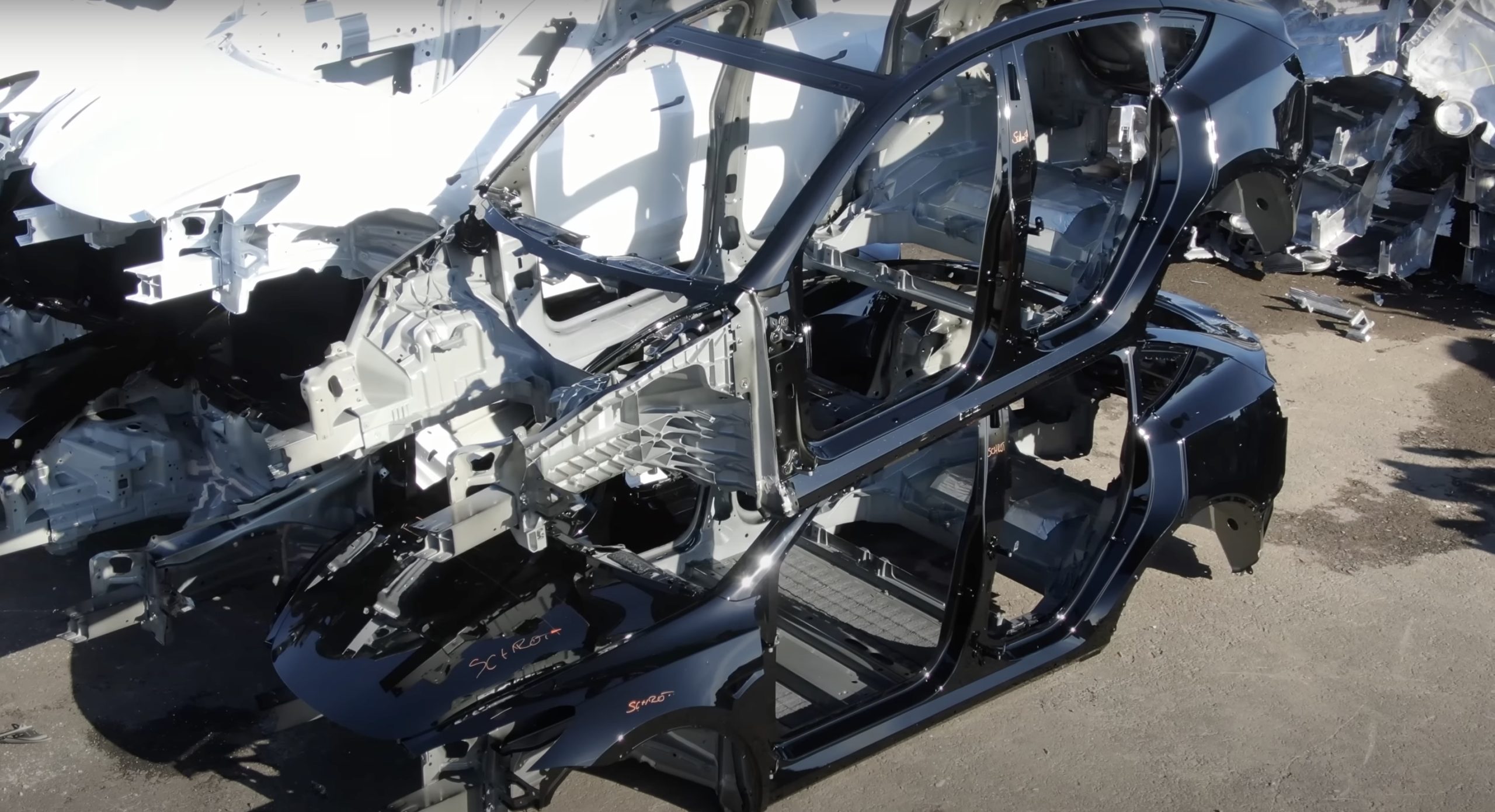
A good friend ordered a new Model S in 2015. It arrived with a "squeak" that turned out to be due to missing welds in structural components of the chassis. They wanted him to sign an NDA to get a replacement vehicle (which he refused to do, both on principle, and because he'd talked to friends about it already). So he was forced to keep his vehicle, which was then repaired under warranty for what they initially said was not a warrantable defect. To quote him "They took a huge proponent and turned them into someone who will never, ever, recommend them"
And this is how they treated their early adopters that were paying $100K in 2015 for their higher end cars.