Ironically, I think that's part of the reason it became trendy to hate on Ruby and Rails: they make it really easy to do things, which means they also make it really easy to do ill-advised things. But that's not really the fault of the lanaguage or the framework - writing good and maintainable code is a skill you need to work at and develop over time, no matter what language you're using.
Ruby is a beautiful language - Rails is opinionated (much like its creator). If the ways Rails is opinionated works well with your use-case, it's wonderful to use but if not, it's simply horrible.
I don't think RoR usage has declined (maybe as evidenced by the number of "I'm a newb" comments here?) but rather think it's become mainstream so it's simply missing the hype it had when it was the new hipster technology.
It's not so different to the same kind of elitism that gives, say, PHP or JS a bad rap.
They just happen to be successful, and popular.
I don't think the trope of Ruby being old and boring is such a bad thing either, it just means it's stabilised and has a strong ecosystem that requires little to no effort to get set up. And it still gets a lot of love with every Christmas release adding something desirable and new.
I also think it will require some immense innovation or paradigm shift to unseat Ruby/Rails as a de-facto framework for rapid web prototyping. I would still kick off a project with Rails in favour of trying to early-adopt some new approach to development.
Just read it and it seems obviously very impressive that they managed to switch from uranium to Thorium. But I do wonder how their trials of fusion reactors are going. Not too long ago there were breakthroughs in this tech. Perhaps if more work got put into this we could finally break the needed gap and produce more power that we put into it. Thus making it a viable and clean power source of the future.
If a fusion reactor with an energy gain of 100 and stable operation in the 10_000_000 second range were announced tomorrow, we would be only 20 years away from breaking sod on the first commercial-scale plant -- if the process goes very smoothly.
From there it would be only 30 to 50 years before fusion was making a significant contribution on a global scale, if it can compete commercially.
If I remember correctly they're also paying into ITER, which afaik is the most promising thing in the works right now (not counting DEMO that's barely started planning), so that'll take a while still.
I've looked through it and there's some nice information on how hacker industry emerged and grew into what it is now, talks about money earned by ethical hacking as well.
I had the luck of visiting post-soviet countries in Eastern Europe, and I can say I was somewhat admired by the block buildings that they have. Rows and rows of massive constructions that look alike, we even visited some apartments, and they had the same room placement, some had really old chandeliers, which gave a strange sense of luxury in a room that's really plain and simple. I think we visited the district where Chernobyl was filmed, but right now I can't remember the exact country.
I think it's somewhat similar to the cookie-cutter houses in the USA: The best possible accommodation for the masses at the least cost possible.
I grew up in one of those blocks till age of 15. They are not all the same but they come in a few types and few sizes. It's strangely comforting to have the house out of the equation, everybody has the same house so it's not a matter of discussion. That said, for some strange reason it was customary to show all the rooms to the people who visit you for the first time.
These blocks are ugly and are getting uglier as they decay but there are many people who "made it" and still live in these blocks and park their Bentleys in the parking that 30 years ago was full of Lada, Moskwitsch and Trabants.
Also, not everyone "made it" so some floors are renovated others are in desperate situation.
They don't necessarily get uglier, as many are insulated/painted/renovated/etc. and become quite presentable, especially if they become a bit more individualized.
But one thing that is noticeable that blocks built earlier (50s/60s) are usually better than those built later (70s/80s). Better quality material, more thought to living spaces around them, playgrounds, etc.
Sad to see the decline. I still don't fully understand - what went so wrong after Khrushchev? Did the leaders just get too old and they couldn't trust new blood in the upper echelons of the party?
(Note: obviously things were bad before Khrushchev too - Stalin was horrible and committed genocide, but he was more purgy and less stagnant than Brezhnev and Andropov)
There is a great movie about a guy that drunkenly gets deposited in the wrong city, which has the same street names, apartments and so on. Hilarity ensues when he's dropped off in front of what he thinks is his house on his street:
A funny Russian movie called the irony of fate actually highlights the phenomenon of duplicated buildings and neighbourhoods. A guy gets home drunk at the wrong apartment which looks identical, even the surrounding streets and names. a good watch
The buildings,while slightly different in design,are very similar to what a lot of countries in Europe were building at the time to meet the needs of growing population. The biggest mistake the urban planners did was underestimation of how many cars there will be in the future. That's why it's so common to have a 12 story building with only 20 or so parking lots.
[Edit]
It's more interesting what happened at the end of the soviet occupation,which is usually less visible to foreign visitors: planning permissions for residential properties were relaxed,which meant that there was no longer any limitations on what kind of houses people could build. And most went absolutely bananas. People started building large,most often tasteless buildings with weird features. Fuel was dead cheap so nobody cared too much about insulation and etc.An example built in 1995:
https://m.aruodas.lt/namai-kaune-zaliakalnyje-kalnieciu-g-pa...
Swathes of such houses were built.
A lot of people did self builds and etc.
In a period of 10-15 years,a new class of rich and super rich was formed. This was followed by formation of gated communities, identical to those in all western countries. There, houses do look very different:
https://m.aruodas.lt/namai-vilniuje-valakampiuose-lauru-g-pa...
The argument could be made, that cookie cutter apartments can be interpreted as “white cubes”[0] - and those are a big thing in the art world, since they allow the art to shine and the room design stays out of the way.
You had all the modern comfort at a reasonable price.
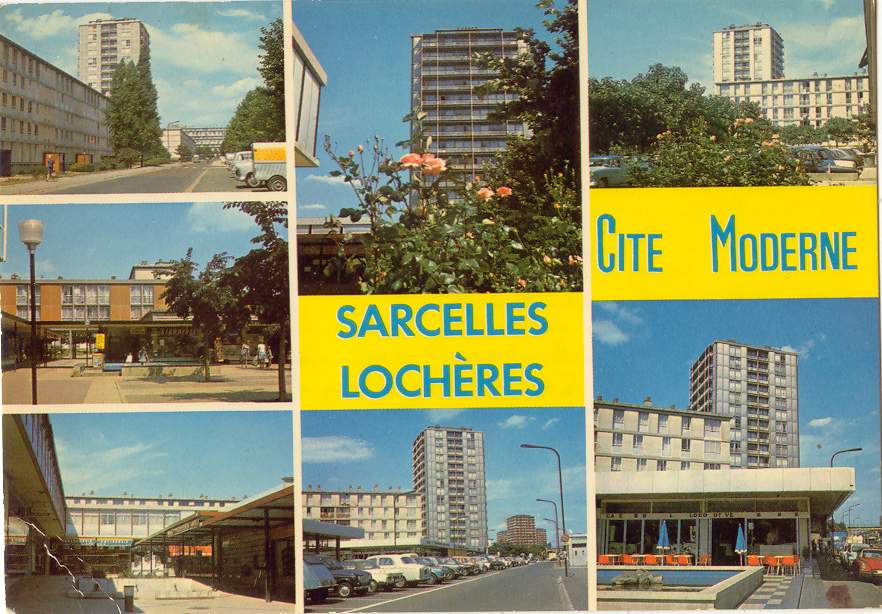
Of course most of these buildings aged terribly and now they're mostly inhabited by very poor people. Now you see these decrepit, often crime-ridden "cités" and you wonder why anybody ever thought that was a good idea.
Pretty much every country has it. Khrushchev implemented their mass deployment in the Soviet Union to stem a housing crisis (I think maybe even as one of his earliest actions as chairman...it's been a while since I read about it in an architecture magazine). Once you recognize the form, you see it everywhere, even outside the Soviet bloc; in the US, Canada, etc. The political influence makes their prominence within the urban fabric rise or fall, but the idea behind the building form is pretty much the same: cheap housing for an increasingly urban population without regard to street life, scale, etc., very much in the vein of Corbusier's Cité radieuse. I suspect the economic argument of that kind of construction was hard to argue with at the time.
Corbusier's ideas were often part of the inspiration, only to get heavily pared down due to cost cutting.
For example, a lot of standardized blocks in USSR were originally planned to be made from large "library of designs" to provide varied and well adapted neighbourhoods, however after first few went through the cost cutting measures meant that they were replicated en masse.
Another example is one I have lived in - the longest building in Poland, at over 1.5km length, nicknamed Beijing by many due to super-high density. Critical changes into how the building was built were made by building company on occasion when architects were not around, resulting in long-term damage to comfort and quality of living. Once the architects were back in, it was too late to fix as you'd have to rip out the foundations and start anew.
Several other more "Avant garde" neighbourhoods in Poland suffered from similar issues, often caused by policy that was supposed to encourage innovation, where "rationalisation proposals" (not a good translation but close) that, for example, would lower the cost, were rewarded and often not well checked (if at all). The initial cost savings then turned into heavy issue later on.
A lot could be also said with regards to non-design problems during building, which caused issues due to materiel deteriorating sitting outside waiting for shipment of components necessary to build the required predecessors to the use of the now-rotting ones.