I think we all can agree that this article is not based on a proper comparison between Tailwind CSS and what the author calls “semantic CSS”. I understand, from authors’ comments here, that it does not aim to be a perfect copy. But arguing that it is 1-3% off, is just BS.
The big problem for me, that the author also argues that the Tailwind CSS version is an official template and, therefore, it has to follow best practices.
I think this logic is flawed, since in production (and especially if I sell templates online) I aim for readable code, which may result in more markup used. Anyone, who knows Tailwind CSS well, could copy the author’s version of the site with the same HTML markup and achieve the same output. Only then it would be a fair comparison, and I bet the results would not be the same at all.
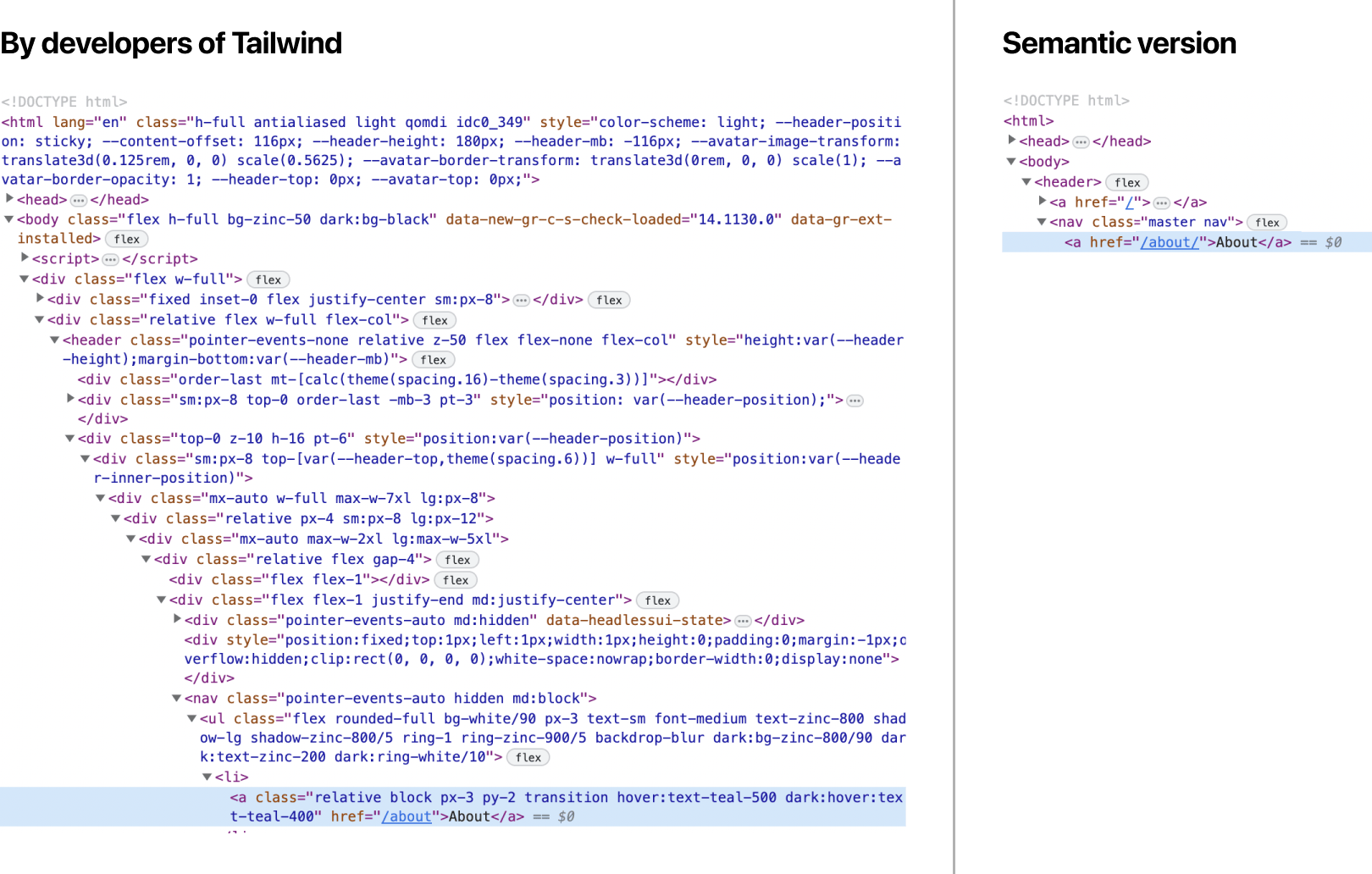
I'm arguing that Tailwind requires _significantly_ more markup to produce the same look and feel. There is no way anyone could implement the semantic version with less code using TW.
And I personally find less code more readable than more code. Particularly with Tailwind where the difference can be 10x or more. I'm talking about this real-world scenario:
The intention is clear, but you are exaggerating your argument by comparing a plane with a car. The Tailwind example is a much more feature complete product, then your „lightweight“ copy. Also, as I said it might be written with another intention then being super small. You use body > header > nav > a. You could write an example in Tailwind that uses the same markup structure, which then would be a valid starting point for an article like this, despite I assume you could not come up with the same conclusions.


The big problem for me, that the author also argues that the Tailwind CSS version is an official template and, therefore, it has to follow best practices.
I think this logic is flawed, since in production (and especially if I sell templates online) I aim for readable code, which may result in more markup used. Anyone, who knows Tailwind CSS well, could copy the author’s version of the site with the same HTML markup and achieve the same output. Only then it would be a fair comparison, and I bet the results would not be the same at all.