You can draw a line between your location and the north pole, they talk about three variants:
- Magnetic North: Shortest surface line to the magnetic north pole (simply in the direction of the compass at your location).
- True North: Shortest surface line from where you are to the geographic north pole (based on the rotation axis?).
- Grid North: A line to the same geographic north pole, but aligned to the longitude lines (EDIT: for a local UK grid standard, slightly different from the global one). I didn't fully understand the subtleties of why it's different from True North, something about the projection. Not sure if it's exactly to the same north pole, the rotation axis might also change slightly and I assume that the grid north point is fixed by convention?
They are saying that there's a particular point where all three lines point in the same direction, and that point is moving.
It's a transverse mercator projection rather than a mercator as you might often see because it minimises distortion over the UK as a whole which means that the distortion is as you move away from the meridian, rather than as you move away from the equator (with a regular mercator I think all points have the grid aligned with true North)
This grid is setup such that it's origin is not on the prime meridian (at Greenwich), but 2deg west so only points on the line 2deg west are aligned with true north.
One of the advantages of doing this seemingly weird projection is that you can treat "local" maps (for some definition of local) as flat rectangular grids without introducing a lot of errors: drawing straight lines between two points, measuring the distance / angle between them, etc., just by dealing with a flat piece of paper. VERY convenient, but the farther you are from the center of the projection, the higher the errors that are introduced.
This doesn't make sense to me, our current prosperity is founded on an enormous mountain of collaboration and shared beliefs. Usually not out of selflessness of course, often guided and forced by strong leadership and/or strong institutional structures to bend selfishness into selflessness (like capitalism to a degree).
Poor countries tend to stay poor not due to fundamental resource constraints but due to self-reinforcing loops of desperate crab-bucket like behavior, where everyone is cheating one another out of necessity (or culture). Broad collaboration and institution building is always the only way out of the hole, although the hole can be very deep and collaboration can be very costly until you get out.
You are right though, that for an individual living in a good collaborative system, often cheating is very effective, it's just that the system can only handle a certain amount of that behavior before it collapses.
As is discussed in the first scene of Plato's The Republic (surprisingly entertaining to modern tastes), the best play tends to be "to be unjust while seeming just". If people are going to be assholes, it is actually much better if they are discrete about it and keep a pretense of civilization. When people start acting conspicuously like assholes, out of a weird sense of honesty, that's when it propagates and the whole thing collapses, like a bank-run. It's an ancient story that we are still living.
> Poor countries tend to stay poor not due to fundamental resource constraints
Sometimes highly shrewd rich countries infiltrate the power structure of poor countries through N-pronged strategy to keep them stuck in a rut so that they don't become future threat, also extract their resources in the meantime.
Indeed, the way out of that is also broad collaboration, sometimes not peaceful or clean.
And the last century showed that this also works at a large scale, we all got a lot richer as a global community by letting poor countries develop and doing business with them, instead of exploiting them to death.
Yes, strongly believe this is the case. The corrupt leaders are rarely chosen by the people; they are installed by foreign powers. There are many cases you can dig into which are absolutely atrocious; like people getting paid big money by western leaders to assassinate their friends to take power and pass laws which facilitate the extraction of resources by foreign corporations.
Like the story of Thomas Sankara's assassination by his trusted childhood friend Blaise Compaoré is quite disturbing. It seems like Compaoré was leader for a very long time and is still in politics... I cannot think of a more morally deprived individual. If game theory was as claimed; nobody should want to work with such deeply disloyal and psychopathic individual. It's just like I say; people have a strong tolerance, even attraction to abusers. If you look at the real story, you notice this pattern over and over... but we are so badly gaslit about such things (aka 'PR') that we don't notice.
Ed Witten here : "So first of all thanks very much. I'm very honored to have the chance to give this talk. Of course Nima and I both wish we could do more for
peace than just to give talks at an online meeting for peace. Unfortunately we know that there are lots of bad things happening in the world and we hope that there will be better days ahead. Hopefully as one would say in Hebrew [..] which means soon in our own day.
> Poor countries tend to stay poor not due to fundamental resource constraints but due to self-reinforcing loops of desperate crab-bucket like behavior, where everyone is cheating one another out of necessity (or culture)
This doesn't seem true and I'd be interested in any stats that back this up. It reminds me of a very interesting result (that most never internalize) which is that the number one way to avoid corruption is to pay public servants handsomely such that the job rivals the private sphere. Most developing countries can't do that, and that's why most of them have issues with corruption.
Rich countries also have crab-bucket like behavior. You don't have to look twice at the current US administration to see lots of corruption and cheating and fraud, for example.
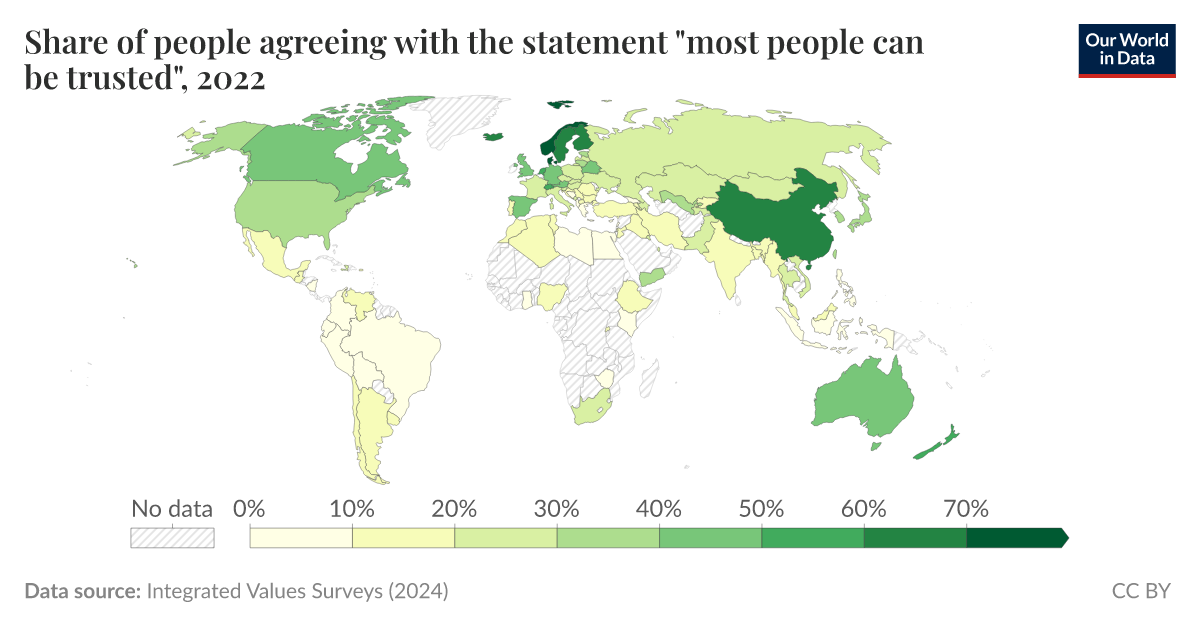
Pretty clear trend: low-trust societies have low gdp and high-trust societies have high gdp, regardless of resource distribution. Africa/South America are resource rich, japan/iceland are resource poor.
Which direction does the causation within that correlation (if any) flow?
I can easily conjure a scenario where high per-capita GDP makes trusting easier (either because there’s enough to go around and/or because there are reliable police/judicial sanctions for violating trust) than in a hardscrabble low per-capita GDP society with lower (insufficient?) lawfulness.
I didn't mean it so literally. Having robust taxation and well supported institutions is what I mean by "broad collaboration" and an effective "culture", as in a social operating-system a set of values and habits, that continually support and self-heal such constructions.
I don't meant that everybody should be nice, and that poor countries are somehow culturally nasty, absolutely not. Real collaboration cannot be just founded on morals and good faith, it's not sustainable, it's more about incentives engineering.
In terms of references, the main one that comes to mind is the economics Nobel price from 2024: "for studies of how institutions are formed and affect prosperity".
> the best play tends to be "to be unjust while seeming just"
Yep this is a huge problem now. I think wealth inequality is also making this worse because people often turn a blind eye to the bad behaviors of people who have power over them. This is an extremely powerful effect; it's everywhere. For example, Christians turning a blind eye to certain negative character traits of God as he appears in the old testament. Employees turning a blind eye to the immoral actions of their boss and coming up with justifications to keep them on a pedestal...
The social structure is not determined by morality; it's the other way round; morality is determined by the social structure.
It reminds me of an old French fable in which a lamb tries to reason with a wolf why he should let him live... The wolf listens to the lamb's logic but then he eats it anyway and the story ends with a sentence like "The reason of the strongest is always the best one."
My point (and Plato's) was rather that some people will definitely cheat, because it's locally rational, and it's actually better for everyone if they are "classy" about it and don't flaunt it too much. A minority will get away with terrible things, but somewhat bounded by conspicuousness, and at least the majority remains blissfully (willfully?) unaware and propping up the civilized system which is so much better for all of us.
It is quite a cynical point of view of course. It's a hard balance, when it gets bad sometimes it's better to air the dirty laundry and go through the pain of purging those cheaters.
But the worse thing is to have people be loud and proud cheaters, which is happening more and more. That's a deadly virus to a civilized society, everyone starts thinking they are dumb for not cheating, and we quickly go back to the dark ages.
It's a bit like calling out the bank for being a fraud because they don't have all the money in a vault, and rushing to get your cash out. If people start taking the red pill and shouting that society is just a game of pretend, which it kind of is, then our very real prosperity can vanish overnight.
>> then our very real prosperity can vanish overnight.
This sentence assumes a certain degree of shared prosperity. I think this is increasingly an illusion. IMO, Social media tends to create filter bubbles which create illusions of shared prosperity. Most of the social bubbles I participate in, the view is much more like 'monopolized prosperity' than 'shared prosperity'.
I've been in a unique position to have mingled with billionaires/millionaires and also normal people and the contrast is significant. In some circles; it's like even the company cook, janitor, receptionist and wall-painter is getting rich... In others, it's like there are some really talented people who keep failing over and over and can't make any money at all from their work; like they're suppressed by algorithms.
I think most people wouldn't mind seeing the whole system collapse as they don't feel they have any stake in it; their experience is that of being oppressed while simultaneously being gaslit about being privileged! It's actually deeply disturbing. I don't think most people on the other side have any idea how bad it is because their reality looks really wonderful.
My view is that the oppression which used to be carried out at a distance in Africa is now being carried out to large groups of people within the same country; and filter bubbles are used to create artificial distance.
My experience of the system is that it works by oppressing people whilst keeping them out of view so that those who benefit from that system can enjoy both physical as well as psychological comfort. The physical comfort is real but the psychological comfort is built on the illusion of meritocracy; which can be maintained by creating distance from the oppressed. It's why the media keeps spreading narratives about homeless people being 'crazy' and 'on drugs' IMO. Labeling people as crazy is a great way to ensure that nobody talks to them to actually learn about their experience. It's the ultimate way to dehumanize someone. Because their experiences would shock most people and create deep discomfort; it would sow distrust in the system.
> This sentence assumes a certain degree of shared prosperity. I think this is increasingly an illusion. IMO, Social media tends to create filter bubbles which create illusions of shared prosperity
I think it's exactly the other way around? Wealth inequality (in the US, as an example) has actually not drastically changed in the past few decades, but I do agree the perception of unfairness has increased a lot.
My hunch is that everyone is now being fed wealth porn on social media and comparing themselves to influencers or actual billionaires who actually do live or pretend to live a .01%er lifestyle.
Life's never been fair; but feeling shortchanged for living a solid middle class lifestyle because Bezos has a big yacht seems new.
Ultimately it all feels depressingly materialistic to me. Go work on something actually meaningful!
> For example, Christians turning a blind eye to certain negative character traits of God as he appears in the old testament.
If I were to extend your analogy, the problem in modern world has become aggresive. E.g. you have committed a crime or fraud. Everyone else has proved decisively and beyond doubt that you have committed fraud such that it has become common knowledge. yet the justice system isn't acting. In a sense, you are taunting and teasing me, "what you gonna do about it?" This is inviting violence. The guy killing insurance company CEO has exactly this line of thinking.
"Therefore Socrates said that it wasn’t enough to use the intellect in all things, but it was important to know for which cause one was exerting it. We would now say: One must serve the “good cause.” But to serve the good cause is—to be moral. Thus, Socrates is the founder of ethics.
"Socrates opened this war, and its peaceful end does not occur until the dying day of the old world."
Plato/Socrates are the original ghost story tellers. I spit on their grave. Republic is easily one of the worst books written in human history in terms of its impact. Right up there with Das Kapital.
Throughout history, real social conversations and movements have happened around thought leaders that dedicate their lives to painstakingly understanding and expressing a certain point of view on a set of issues. Be it in written form or through oratory, it then acts as an anchor to frame and facilitate conversations between people one-on-one.
Real progress requires that hard work of crafting and spreading a vision, something to point at that helps people express what they struggle to express themselves. It also then needs that protected intimacy of long conversations between individuals to digest it.
The architecture of social media centered around short-form public communication is not appropriate for this.
This of course applies to both constructive and destructive movements, but it’s the only way to get big real things done. I suppose that’s why we have this emergent class of powerful independent (podcast) intellectuals after a long time of the concept not being a thing. Again, for better or worse, plenty of both.
If serious conversation isn't possible on social media, then what do you call this?
Is the conversation we're having now not both serious and on social media?
I think if the great minds of old had access to our modern internet, they would have no trouble communicating their ideas. It's not like all social media is short form. You can type a whole book into the comment box here if you want.
This is a really good explanation, but it reinforces my understanding that these “junk maths” are literally undefined behavior as in C and such. They are not defined (in maths), you are not supposed to trigger them, so they can be anything. Great…
This is horrible for a language whose whole purpose I thought was that to be foolproof and that if it compiles its true. Having very subtly different definitions of common operations is such a footgun.
Of course, I understand that this doesn’t bother mathematicians because they are used to not having any guardrails anyways. Just like C programmers have the attitude that if you fall on such a trap, you deserve it and you are not a “real programmer”. But Lean is supposed to be the other extreme isn’t it? Take nothing for granted and verify it from the ground up.
I suppose I am falling for that “Twitter confusion” the post is referring to. I never had any issues with this when actually using Lean. I just don’t like the burden of having to be paranoid about it, I thought Lean had my back and I could use it fairly mechanically by transforming abstract structures without thinking about the underlying semantics too much.
Anyway, despite the annoyance, I do assume that the designers know better and that it is a pragmatic and necessary compromise if it’s such a common pattern. But there must be a better solution, if having the exception makes it uncomfortable to prove, then design the language so that it is comfortable to prove such a thing. Don’t just remove the exception because 99% of the time it doesn’t matter. If we are happy with 99% we wouldn’t be reaching for formal verification, there are much more practical means to check correctness.
There is still a guardrail. The blog post explains that it is just using different functions and notation which might allow things like 0/0. But at the end of the day, different notation still cannot be used to prove false things.
In other words, you can use all these junk theorems to build strange results on the side, but you can never build something that disagrees with normal math or that contradicts itself. There is no footgun, because the weird results you obtain are just notation. They look weird to a human, but they don't allow you to actually break any rules or to prove 1=0.
I understand that, but if "/", and other common operators, don't mean what they means on paper, you can prove things that would be untrue if copied onto paper (kinda). You can indeed prove "1/0 = 0", which is not that far off from redefining "=" and proving "1=0".
More importantly, the other way around, it seems too easy to copy a proposition from paper onto Lean and falsely prove it without realising they don't express the same thing. A human probably wouldn't but there's increased usage of AI and other automatic methods with Lean.
I do understand I'm being purist and that it doesn't matter that much in practice. I've used Lean seriously for a while and I've never encountered any of this.
This is very interesting. What happens if you keep pulling the thread and construct large theories on such abstraction-layer-breaking theorems? Would we arrive at interesting things like pulling the thread on sqrt(-1) for imaginary numbers? Or is it somehow “undefined behavior”, quirks of the various implementation substrates of abstract mathematics that should be (informally) ignored? My gut says the former.
Are the various alternative axiomatic foundations also equivalent at this level or not? I suppose they are since they can implement/emulate each other, not sure.
I don’t understand why most people in this thread think that this would be such a big deal. It will not change the market in significant negative or positive ways. AMD has been at their heals for a couple of decades and is more competitive than ever, they will simply fill their shoes. Most games consoles have been AMD centric for a long time regardless, they’ve always been fairly dominant in the mid range and they have a longstanding reputation of having the best price/performance value for gamers.
Overall, I think that AMD is more focused and energetic than their competitors now. They are very close to taking over Intel on their long CPU race, both in the datacenter and consumer segments, and Nvidia might be next in the coming 5 years, depending on how the AI bubble develops.
Why would AMD shareholders tolerate them engaging in gaming pc market if Nvidia drops out? They might last a couple years but I mean the writing will be on the wall for them to chase enterprise sales and abandon gamers. Especially when game console manufacturers would prefer you spend $25 a month for life instead of buying a $500 console every 8 years. There won't be an xbox or playstation in your house before long.
Sure the gaming hardware landscape is likely to change, but it won’t be up to Nvidia’s decision. If it remains a viable business, it will thrive whether Nvidia is in it or not.
They’ve become a big name now with AI, but they were never the only game in town in their home markets. They had an edge on the high-end so their name had some prestige, but market share wise it was quite even. Even with AI, they have a temporary head start but I wouldn’t be surprised if they get crowded in the coming years, what they do is not magic.
For people that like functional style and using recursion for everything, TCO is a must. Otherwise there’s no way around imperative loops if you want decent performance and not having to worry about the stack limit.
Perhaps calling it an “optimization” is misleading. Certainly it makes code faster, but more importantly it’s syntax sugar to translate recursion into loops.
You don't need full fledged TCO for that; see Clojure's recur for an example. Zig recently added something similar but strongly typed with match/continue. These all map exactly to a closed set of mutually recursive functions with a single entry point, which is quite sufficient (and then some) to fully replace iterative loops while still desugaring to the same exact code.
Indeed there are more explicit versions of such mechanisms, which I prefer, otherwise there’s always a bit of paranoia about recursion without assurance that the compiler will handle it properly.
I did like it, but for me it was fixated on 3-5 comments from the last 1-2 months that got a few more upvotes. It didn’t really work as an overview for the year. Still, a pretty cool thingy :)
Yeah, same here. For the comments it took into account it made pretty great roasts, but would have been better if it was actually comprehensive over the course of the year.
Thanks. I now run a two-step process: first pass reads through all posts and comments to extract patterns, second pass uses those to generate the content. Should be much more representative of your full year now :)
My impression was the same as the poster: it still over-indexes on a couple of recent posts.
Of course, it's possible that we've both been repeating ourselves all year long! I mean, I know I do that, I just think I've ridden more hobby horses than it picked up. :-)
It's fun, though. Thanks for sharing - a couple of my "roasts" gave me a genuine chuckle.
LLMs certainly struggle with tasks that require knowledge that is not provided to them (at significant enough volume/variance to retain it). But this is to be expected of any intelligent agent, it is certainly true of humans. It is not a good argument to support the claim that they are Chinese Rooms (unthinking imitators). Indeed, the whole point of the Chinese Room thought experiment was to consider if that distinction even mattered.
When it comes to of being able to do novel tasks on known knowledge, they seem to be quite good. One also needs to consider that problem-solving patterns are also a kind of (meta-)knowledge that needs to be taught, either through imitation/memorisation (Supervised Learning) or through practice (Reinforcement Learning). They can be logically derived from other techniques to an extent, just like new knowledge can be derived from known knowledge in general, and again LLMs seem to be pretty decent at this, but only to a point. Regardless, all of this is definitely true of humans too.
In most cases, LLMs has the knowledge(data). They just can't generalize them like human do. They can only reflect explicit things that are already there.
I don't think that's true. Consider that the "reasoning" behaviour trained with Reinforcement Learning in the last generation of "thinking" LLMs is trained on quite narrow datasets of olympiad math / programming problems and various science exams, since exact unambiguous answers are needed to have a good reward signal, and you want to exercise it on problems that require non-trivial logical derivation or calculation. Then this reasoning behaviour gets generalised very effectively to a myriad of contexts the user asks about that have nothing to do with that training data. That's just one recent example.
Generally, I use LLMs routinely on queries definitely no-one has written about. Are there similar texts out there that the LLM can put together and get the answer by analogy? Sure, to a degree, but at what point are we gonna start calling that intelligent? If that's not generalisation I'm not sure what is.
To what degree can you claim as a human that you are not just imitating knowledge patterns or problem-solving patterns, abstract or concrete, that you (or your ancestors) have seen before? Either via general observation or through intentional trial-and-error. It may be a conscious or unconscious process, many such patterns get backed into what we call intuition.
Are LLMs as good as humans at this? No, of course, sometimes they get close. But that's a question of degree, it's no argument to claim that they are somehow qualitatively lesser.
Late to this, but my interpretation of the parent's point was eg: LLMs still often produce bad code, despite "reading" every book about programming ever written. Simplistically, they aren't taking the knowledge from those books, and applying them to the knowledge of the code they've scraped, they are just using the scraped output. You can then separately ask them about knowledge from those books, but then if you go back and get them to code again, they still won't follow the advice they just gave you.


You can draw a line between your location and the north pole, they talk about three variants:
- Magnetic North: Shortest surface line to the magnetic north pole (simply in the direction of the compass at your location).
- True North: Shortest surface line from where you are to the geographic north pole (based on the rotation axis?).
- Grid North: A line to the same geographic north pole, but aligned to the longitude lines (EDIT: for a local UK grid standard, slightly different from the global one). I didn't fully understand the subtleties of why it's different from True North, something about the projection. Not sure if it's exactly to the same north pole, the rotation axis might also change slightly and I assume that the grid north point is fixed by convention?
They are saying that there's a particular point where all three lines point in the same direction, and that point is moving.
reply