Ok, there probably are folks who can't differentiate between the Physics department and the Sociology department. Or who can tell the difference but who attack both anyway.
The problem for science is those folks. Right? The universities are actually teaching and advancing science. They're not the problem. The Pol Pot types are the problem. We know this very well from history.
I think you're massively overselling "Moldbug"'s influence. Most on the right today dismiss him for being jewish. Older right-leaning people are mostly stuck on the Facebook/Fox News reservation and don't read essays or blogs, ever, and probably aren't even literate enough to understand Yarvin let alone get talking into monarchism by him.
I will grant that he has influence, but definitely not "massive". Maybe he has traction with tech business elite as some say, I don't have a read on the pulse of that ultra-niche demographic.
“He has no influence… except perhaps among a small group of the most ideologically extreme, politically active, industrially dominant, and financially resourced people on the planet”
No one thinks Yarvin is popular. They think (know) he’s influential among the very specific small group that you disclaim any knowledge of.
I said monarchists are rare. I maintain that they are, even if rich people rank among their numbers. About the only people from whom you could expect an affinity for monarchism, in America, are rich people who consider themselves aristocrats already (who although powerful, are very few in number) and weird greasy kids in highschools.
Incidentally, I did stumble across the existence of a group of genuine monarchists in America a few years back. They're a sort of Catholic... [Association? Cult let's say] who think the French revolution is the root of all modern evil and instead all government should be subservient to the Catholic church. But their group dates back to some guy in Brazil in the 20th century. These guys are genuine though, not internet larpers or people being edgy for lulz. They're also very obscure and extremely fringe. Almost like the Catholic version of the Westboro Baptist people.
Eh, I've met at least one "monarchist" (blurry boundary between that and fascist, per his own words) who doesn't fit that description at all. There are people out there who just want to be dom'd by some old man in DC.
And yes, you did say they are rare. Then you said they're not influential while carving out the one major source of alleged influence.
I don't take any issue with the rarity claim, but it's at this point dangerously naive to act like Yarvin's incredibly unimpressive and juvenile ideas aren't literally shaping our daily lives as we speak.
"Most" on the right will play dumb when you bring up Project 2025 too, which he architected, and which is getting played out in front of our very own eyes, day in and day out.
It's always amazing how many people plop anti-consumer comments out here. Like, of course you bastards deserve to be served ads on your own TV that you just paid $800 for. Because why? Because ... the market is wise, and "the market" is screwing us, so ... we must ... deserve to be screwed?
Whatever is being offered to us must be the best deal we can get, because ... it's being offered to us?
What drives this sentiment? Is it Stockholm Syndrome?
Exactly. The free market has very little recourse when companies basically all start doing the same thing, and more or less don’t tell you about it. You certainly don’t see “takes a screenshot of your TV every 2s and uploads it for us to analyze” plastered all over the boxes! I guess the idea is the consumer will be omniscient and that a company will come along offering a privacy protecting alternative… but those incentives just doooo not work!
Seriously, totally deranged to think the “free market” is capable of protecting humans against widespread nefarious behavior from colluding actors with vast amounts of money and power.
A free market would be great and perfectly capable of serving the public. The problem is free market is a theoretical concept and markets like electronics are nowhere near free. Collusion is something that happens in an oligopoly. The fact many markets degenerate into oligopolies and monopolies is why we need government. 30 years ago I feel like people understood this. Now it seems everyone thinks they know what free market means just because they heard the term one time.
"A free market would be great and perfectly capable of serving the public. The problem is free market is a theoretical concept"
How would we know the real-world properties of a theoretical concept from economics? We understand pieces of economics, but certainly not the whole thing. Let's say we make the market free-er and free-er. Apart from politics junkies, who knows for sure how that behaves?
I like this branch of discussion and I want it to keep growing. What has to happen to make an electronics market free? Is the situation about spyware TV/cars can not be improved in any kind of Libertarian or Anarcho-Capitalist world without the Government? Is bad government worse for the electronics market than absence of any governments?
Some things like semiconductor fabrication will have huge barriers to entry for the foreseeable future due to being massively capital intensive and involving lots of trade secrets etc. We can't really do much about this.
What we (ie. the government) can do is ensure no entities own the entire supply chain, so you can't run a fab and also market finished consumer goods. That way, manufacture of consumer goods (including the software) from the raw fabricated parts gets a much lower barrier to entry.
We can also force consumer manufacturers to advertise all "features" that we deem to be important. We already do things like energy ratings, why not privacy ratings too? The more information consumers have the better.
Make no mistake, any capital intensive industry like electronics will degenerate into an oligopoly without government, or you can dream of a day where everyone can print semiconductor wafers at home.
It's driven by the fact that many of these people work for companies doing similar things, and this is how they resolve the cognitive dissonance. Otherwise they'd have to accept that their work is unethical.
I've wondered about cognitive dissonance. Another "cog diss" possibility is, maybe I have a strong aversion to admitting that I'm getting screwed. Maybe I can relieve those feelings by arguing publicly that I'm not getting screwed. Or that it's "inevitable" for me to be screwed.
Because the companies are selling technology to us cheaper than cost in exchange for this? I do think they should be required to offer a revenue-neutral way to turn off ads but it would cost several hundred dollars and only me & 5 other weirdos on this website would buy it.
We all know that they would artificially increase the price of those models and exclude tons of features to punish users and say it’s not profitable.
They should not be allowed to track user at all as a hardware manufacturer, let the users purchase the tracking software themselves and get a rebate back.
That may be a good point. But I don't think it's an answer to my question.
My question was, Why do people get so passionate about being screwed? Say consumers really are receiving a $300 discount in exchange for being forced to watch say 30 hours of ads. Is that really such a fantastic opportunity that I'm going to go cheer for it publicly, or claim it's consumers' fault, or it should be mandatory, or we must just accept it because (whatever)?
I think most people don't see the basic trade of "you charge me less but get my data & my attention" to be a bad deal, particularly when the upside is a large TV which was a _huge_ status symbol (for better or worse) not even 15 years ago.
I'll speak for myself. I think it's pretty universal that when someone says "I want X", people believe them. Where I find myself slightly rarer is that when someone's purchasing decisions says "I want X", I believe them.
People seem earnestly willing to trade their attention and data for ~a couple hundred dollars (this was my best estimate of how much cheaper ads make TVs - about $50 per year of ownership with 5ish years of ownership typical). I am much more worried that people who are not earnestly willing (me and the 5 other weirdos mentioned in my OP) don't really have a good outlet. It would be a genuine loss if the government no longer let people trade their attention and data for a cheaper TV, according to the people (I really had to resist capitalizing there) themselves. I don't have to like it to believe them.
I don't like ACR at all.. but after reading all the raging about ads on TVs I thought they would be terrible. Then I got one recently - the ads are literally just links to watch movies & TV series I might be interested in, on my TV? Like yes I do want my TV to show me some things I might be interested in watching, the same way Youtube does. I don't like the increasing privacy violations like ACR being used to tune those "ads", but seeing recommendations on my TV is a feature I like..
Heck if I had strong guarantees that the data generated by ACR was used only to tune recommendations/ads using an anonymous advertising ID like IDFA and not linked to any personally identifying information, I would want that too. But sadly there is no privacy and no way of ensuring that now.
Not everyone feels like that. Yesterday the app of my tv provider on my Samsung TV home screen suddenly shows a Prime icon in its place, prompting to install the app if you use muscle memory to control the TV. I am unable to remove this annoying ad. I really really hate ads and will go to great lengths to avoid seeing any in my private home. So I see this as an invasion of my privacy. Not buying Samsung anymore.
My guess is that most people on HN work for companies that are in some meaningful way doing the same thing. What would be called spying 50 years ago is now the bedrock of how tech either makes money or improves their products.
But I didn't really ask "why do some consumers prefer not to make certain unwanted features illegal"? I asked why some consumers are so wildly positive about being forced to adopt features they hate.
Lemme example. In the weed space, I don't think anybody would take this seriously: "well it's illegal and there's nothing we can do about that so it's pointless to discuss dissenting views." Or "it's going to be legalized and there's nothing anybody can do about that, so there is no possibility of debate." People would just laugh at that.
But when it's normal consumer activity, those same arguments seem to cut ice. Why?
I feel this is a generally strange situation. TVs seem to be pretty much the only tech that is somehow inflation proof, and that is largely due to the surveillance capitalist approach they come with.
I am a strong privacy advocate, but I also believe in customers choice. Hence, the primary issue I have with this technology is not its existence, but the lack of transparency in the pricing and the inability to truly properly opt out of this data collection.
At some point in the past year, I‘ve read someone suggest a „privacy label“ for electronics, akin to the energy efficiency labels that exist around the world. The manufacturers should be forced to disclose the extend of the data collection as well as the purpose and the ability to opt out on the product packaging, before the customer makes the purchase
Sure, but medieval European art generally sucked. (Call this a hypothesis if that helps.)
Compare the damn cave paintings of buffalo to most medieval European art. Some of the 10k-year-old stuff is much better observed. Europeans between about 500 and 1300 mostly couldn't paint. I'm sorry about that.
It's just not always taste. Sometimes it's taste. Sometimes people are bad at making art.
I think that the medieval art article is making a different point. The art there had a style that was dictated by its purpose and the beliefs of the artists.
For example, most of the examples given in that article are illustrations from manuscripts. This was something (as far as I know) that was new in the western world. The idea that books should be illustrated. And being before the printing press was introduced, each illustration (of which there were often many per page) was hand made. This added a substantial amount of time to an already labor-intensive process. And each image was not intended to be a standalone work of art.
Also, some of the other examples are of iconography. That style remains, largely unchanged to this day. If you do an image search for "religious iconography", you will see plenty of examples of sacred art that are not visually realistic but are meant to be metaphorically or spiritually realistic.
Sure, but for me the standard isn't whether it's visually realistic. Plenty of good stuff isn't particularly realistic. Traditional Chinese landscapes aren't realistic, but a lot of them are great. David Hockney has a lot of good work that isn't realistic and uses primitive-looking technique. The standard is not realism or which style was used. The standard, for me, is whether the artist was any good at art. Hockney is. (Usually.)
I'm not particularly basing my opinion on the examples in this article. It's easy to see that a lot of surviving European medieval art sucks. Maybe "surviving" is the problem. Maybe the good stuff got all smokey from being displayed and only the leftovers and student paintings, in storage, have survived.
On illustrations, everybody can see the difference between Durer and most medieval stuff. It's not simply style or taste.
So, just to make it clear… you define good art by “whether the artist is any good at art”.
Illuminating…
——
For anyone who’s interested in a slightly more nuanced take on how people in the Middle Ages perceived of “art” — and how different that notion was to how we perceive it today — Forgery, Replica, Fiction by Christopher Wood [1] is a really interesting read.
Here’s the last sentence of the Goodreads summary, which describes the major transition in thinking:
“… Ultimately, as forged replicas lost their value as historical evidence, they found a new identity as the intentionally fictional image-making we have come to understand as art.”
Mmm both of those are from 1400s and OP do limit it to 1300. And that 1300 limit is for good reason. Renaissance is usually dated after 1453 and that's when European art quality exploded. So yeah, those examples instead prove OP's statement.
If you want to nitpick, I can point out that the full quote is "Europeans between about 500 and 1300 mostly couldn't paint"; stress on "about", and those aren't paintings.
Besides the comment started by saying that "medieval European art generally sucked", so it covers the work I mention.
That's if you want to nitpick. If you don't, both those works are hallmarks of medieval art and while they're not necessarily exemplars, it is important to remember that there were still artists who knew their stuff in and out in medieval times and the Renaissance didn't come out of nowhere.
Edit: I travel through Europe by train a lot (mainly France and Italy but also Switzerland and Germany occasionally) and I visit museums, cathedrals, and art galleries in every city I stay. I have seen a lot of medieval art because those places just seem to have it lying around by the bucketload. There is a broad range in quality, but I have seen some very high quality woodcuts and, indeed, paintings, although those tend to be religious icons. Sculptures also, but mainly in statues of saints on the outside of cathedrals (see e.g. the Rouen cathedral). I'm trying to say that I'm not some kind of art authority or expert on medieval art, but I have seen my fair share of it, and no, Europeans didn't just suck at art in the medieval. I think what happened is there was a lot of mostly religious art that was lower quality, sort of like you can find plenty of slop on the internet today, but there were still skilled artists that created shockingly good art. You'd be more likely to find it in the palaces of the rich and powerful, I reckon, because they were the ones who could afford/support talented artists, as opposed to more ordinary craftsmen, who would be paid less. For the same reason you might find less of the good art lying around than the rougher, cruder kind, because the former was more expensive and thus harder to obtain. This also goes for religious art, which tended to include a smorgasboard of art forms, from painted icons and sculptures to reliquaries and liturgical equipment like communion chalices. But good medieval art existed, I've seen it, and it wasn't that rare.
And if we move the cut-off all the way to 1450, fuhgeddaboudit. You have freaking Albrecht D\:urer by that time. No fair. I'm sorry. The challenge concerned a particular 800-year period, which I chose carefully.
Yes I hear you about the range of quality. You're right. Many of the best pieces may have been "exhibited to death." There was presumably lots of student art and whatnot, probably not considered very good at the time, but it happened to survive. I accept that. But I'm only asking for a single counterexample in an 800-year block of time. I think that's fair.
If you like, though, I'm happy to amend my claim to this: "No, medieval European art did not suck. European art between 500 and 1300 sucked. But from 1300 until whenever the Renaissance starts, watch out. Those folks did some really nice work."
Well then that's not nitpicking, it's cherry-picking, trying to fit your claim into a specific but arbitrary period. You start by saying "medieval European art", then you reduce that to "between about 500 and 1300". Why between 500 and 1300 specifically? What happened to the other ~200 years?
It doesn't matter. There was plenty of good art between 500 and 1300 too. I mentioned the Rouen cathedral, whose west front, the one with all the statues of saints and the hyper-detailed architecture wikipedia tells me was "first built in the 12th century, entirely redone in the 13th century, and then totally redone again at the end of the 14th century, each time become more lavishly decorated" (https://en.wikipedia.org/wiki/Rouen_Cathedral#West_front). That's just one example that fits your spec, that I have personally visited. As I say I'm no expert.
Here's another: the sixth-century basilica of San Vitale in Ravenna, Italy, with some of the most famous mosaics ever, including those depicting emperor Justinian, his wife, empress Theodora, and his court, which again Wikipedia tells me were completed in 547.
With a cursory look online I can also find a bunch of other famous art pieces from your chosen period that I haven't seen myself, like e.g.the Diptych of the Virgin and Child Enthroned and the Crucifixion (https://www.artic.edu/artworks/16241/diptych-of-the-virgin-a...) which however is very typical of the ecclesiastical art I've seen in many museums and art galleries I've visited.
So I do think your claim is a bit exaggerated, even if you try to limit the time period carefully. There was always good art made in Europe.
Btw, I'm Greek so I'm not offended by your claim about Europeans, in case there was a lingering doubt about that. The Greek middle ages (i.e. Byzantium) are usually not included in the European middle ages but Byzantium produced absolutely gobsmacking art throughout the medieval so leaving it out is also a bit arbitrary (but that's not your fault).
The Rouen Cathedral is so impressive that I find it suspicious since there's nothing like it in that period. I think the "and then totally redone again at the end of the 14th century" (after 1300) carries the answer but I doubt I can find proof of what it looks like before that.
San Vitale is also so impressive that I think it heralds the end of that golden age. Nothing will be like this for 800 freaking years In contrast, that diptych from 1275 looks like it heralds the end of the dark age and it do looks like it (starting to be good but nothing like what'll come after it). So if we cherrypick again a little bit, 550-1250 is quite a long dark age.
Regardless of definition of "medieval" here, there still seems to be a very long contiguous era where there is dearth of good European, especially western/northern, art.
I won't bother getting into trying to demonstrate Medieval art doesn't "suck", it's not worth dignifying. But you should be aware you might be placing too much emphasis on painting and drawing specifically as opposed to other art forms.
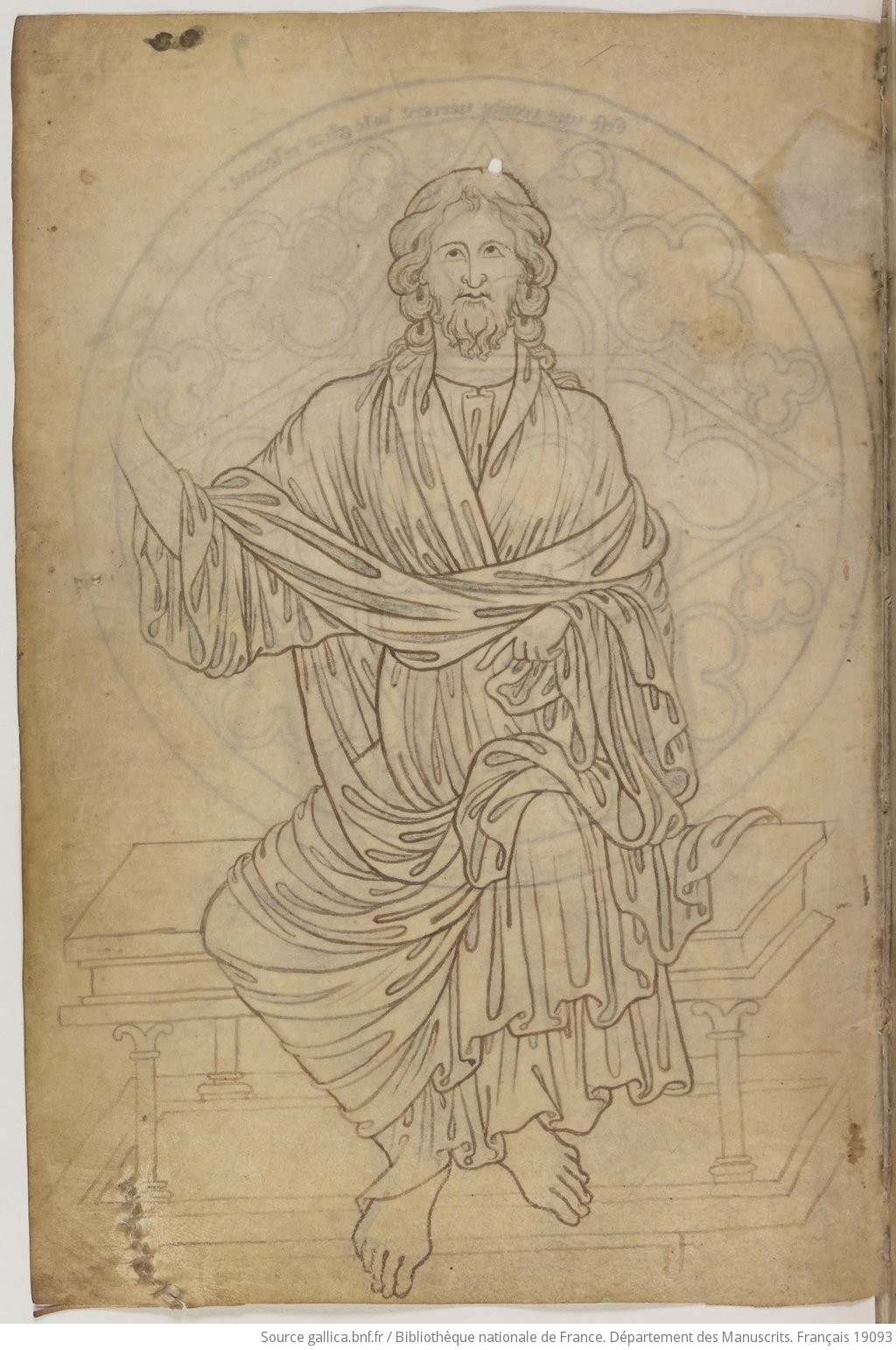
Medieval art is very stylised, but the quality of the lines, the details in the clothes, the crispness of the composition, all that requires a lot of skill. Check out Jean Bondol’s work for instance https://artsandculture.google.com/asset/tapisserie-de-l-apoc...
You may not like the style, but being able to produce works like that requires you to be good at art on some level.
Ok, but the Honnecourt sketches are kind of strong. Not professional by today's standards, but decent. I'd be happy to have done them--but I'm not an artist. The tapestry can be appreciated, like Klimt's 2-D-ish stuff can be appreciated. The style is fine. It's not fantastic work, I wouldn't hang it up, but it's reasonably accomplished.
In general, though, yes, I think medieval European artists were short on skill compared to artists from Europe in pre-medieval and post-medieval times, and art from other places between ~500 and ~1300. They had some skill, but not as much.
Artists with limited technique are a real thing. Not everything is taste or style.
The clothing does often look good. In folio 16v ( https://www.medievalists.net/wp-content/uploads/2024/12/Vill... ), it's been overdone and appears to be far wrinklier than fabric could support, suggesting that Jesus is embedded in some kind of strange plant.
The faces are terrible in all cases.
In general, perspective is off, anatomy is off, and you get shown things that aren't physically possible.
The Honnecourt illustrations strongly suggest that (a) photorealism is the goal, but (b) Honnecourt doesn't know how to draw it. He does things like place a person's right eye at a different angle to the rest of the face than the left eye has. But hey, how likely is it that viewers will notice a malformed human face?
What do you mean by “exceptions”? Who are we, in our own infinitesimal slice of human history, to judge historic taste in art? And is naturalism the be-all, end-all of good taste? If so, we need to throw out the majority of art in the 20th century.
This is a question for an art historian, not some anon on a tech forum. (For what it’s worth, I find Medieval and Renaissance art to be about equally tepid despite the difference in execution. And plenty of people non-ironically enjoy Medieval art despite its supposed deficiencies.)
Like I said, I find the majority of European art before 1800 or so to be fairly dull, so I can't really answer this question. The prevailing technique improved remarkably post-Renaissance, and that's enjoyable to an extent, but the same themes get repeated over and over and over again.
If you're looking for art with an impact, the iconography of Andrei Rublev (and other icon painters during this period) is still massively influential in the Russian Orthodox Church today. 600+ years of direct use and inspiration! The lack of naturalism is not a deficiency.
The problem is not a lack of naturalism, it's obvious mistakes in the way the naturalistic poses are attempted. Many of Rublev's icons have obvious mistakes in the way joints are painted, for example - but not all of them or the exact same thing; it's not a style, it's simply a limitation of his skills. Many later painters who were inspired by him have corrected this mistake, not sought to reproduce it.
Not to mention, Rublev lived at the end of the Medieval period, and well into the Renaissance - the period where painterly skill in Europe was revitalized.
Again, I’m not sure why it matters. Henri Rousseau couldn’t draw for shit and yet people adore his art. The represented idea and its aesthetic execution are what people mostly respond to, not how realistic a figure’s joints happen to be. (And FWIW, a large number of Renaissance painters clearly have no idea what a female body looks like.)
Yeah he's good, that's obvious. Klimt cribbed from Rublev I bet. Naturalism was never the topic. But note that Rublev didn't do much work between AD500 and AD1300. Because not born yet. This is precisely why I wrote down dates, and why I am insisting on counterexamples instead of vague generalities.
Your exposure to medieval art must be very limited. I have seen some very magnificent pieces of medieval art personally. And paintings are a small part of what falls under "medieval art". Include those in the category, please.
And there is another element to consider, which is the purpose of the art. Medieval art was not concerned so much with realism, but with the symbolic.
I wonder: do you think Byzantine icons "suck"? I suspect you do.
What would be the point? Any example given will be met with some snarky and ignorant remark. Veit Stoss's Krakow triptych? Gentile da Fabriano's "Adoration of the Magi"? Byzantine art, like Monreale Cathedral? The Christ Pantocrator icon from St. Catherine's Monastery? Romanesque and gothic cathedrals? Ornate illuminated manuscripts? Shall I continue? You don't have to like medieval art, but claiming it "sucks" is not only generalizing (your very accusation in this thread), but it is boorish and ignorant. You've already gotten more "discussion" out of this topic than you deserve.
I checked your first example. It's from 1423, well outside the time period 500-1300. If you have valid examples, including the other works you mentioned above, please provide dates. I'm a little tired of doing that for people.
Meh. Maybe. Or maybe "click bait" is a better guess than "trolling". Or even maybe he's right, despite writing something "terrible."
1. The professional qualifications of the people doing the actual work should be taken seriously. But the professionals have no control over the people who dictated how the work should be done, or the people who thought out the marketing. I hope this point is clear to engineers.
2. Even if the "trolling" sentiment is both incorrect and "terrible" ... ok. Noted. That doesn't destroy the value of the whole article.
Screed:
Many of us have reached the point where we throw away the baby if we find the slightest imperfection in the bath water. This now includes medicine, values, science, and (at least in the US) our freedom and our functioning society.
We need to grow up. Another example that many modern folks cannot handle is errors in the scientific literature. The scientific literature is incredibly valuable, despite also containing a lot of errors. That's life. Reading the literature is like fixing a car or playing an instrument. It works fine if you know how to use it. We need to grow up and deal.
Obviously getting people hooked on harmful lies was not originally populism. But now it sort of functions like populism. Now it hurts when the lies stop.
I think we've all been the one who got fooled in some relationship. Maybe for you it wasn't a political party. But I bet it still hurt.



The problem for science is those folks. Right? The universities are actually teaching and advancing science. They're not the problem. The Pol Pot types are the problem. We know this very well from history.
reply