Why does everyone immediately pivot to EVs on this subject, instead of (looks around) gargantuan SUVs and trucks everywhere, due to peculiarities of US policies regulating SUVs more leniently than cars on fuel efficiency?
I say this as someone who owns an electric scooter and whose next car will be an EV—the sales pitch for EVs right now is basically pay more (especially now that the tax credit is gone) to have a worse time and maybe eventually claw some of it back over the lifetime of the car in fuel savings. The environmental impact is the pro in the pro con list. So if that doesn't pan out, or doesn't pan out enough it's going to be a tough sell.
Just the cost to get my garage outfitted with a charging port is about to be in the thousands because it requires me to replace the entire breaker panel. Now this is a me problem because that panel is ancient but it does add to the total cost of "doing this" and going EV.
What do you mean by a worse time? The advantages are substantial- No oil changes ever again, performance that is on par with high end sports cars, less moving parts which should lead to higher reliability, in my state you don't even need to do an annual inspection. Those types of unexpected appointments are what really aggravate me when they are unexpectedly needed and eat up weekend time.
Depending on your commute length, you may be able to just use your regular plug to top up over night. Infra upgrades to support the future are unfortunate, but it should be a one and done kind of thing. It was probably time to update the panel and get 200 Amp service- you will recoup a portion of that if you ever sell the house.
The best part is batteries get signficantly (for some values of signficant) cheaper and better each year. Gen 1 Nissan Leaf owners can now actually replace their batteries for about 1/5th the initial pack cost and increase their range.
When operating beyond your comfortable range you have to strategically plan charging the way shitbox owners have to stop and top up fluids. If it's your only car it's absolutely a degradation in the ~monthly ownership experience though you (in my opinion) make it back not doing oil changes and the like.
Even without the tax credit I still think that EVs are a great buy for most though. Charging shenanigans is simple and a "known known" whereas ICE maintenance is far more unclear at the time of purchase
So I was actually looking at it yesterday, and the top end ranges of todays EVs are actually the same range as my 2007 Honda Accord. Maybe I am unique, but I have never taken a road trip so long that I needed to get gas midway going one way, maybe this is more common out west. I have done some round trips for sure though that would require a top up on more than a charge.
I was surprised though that ranges, at least on the top end and very expensive EVs, are now comparable to ICE cars. This will continue to improve and hopefully alleviate any form of range anxiety in the future, especially as chargers just become more ubiquitous. I feel people really fail to realize they can just essentially top up each night and start out with a full "tank." I don't know, it all just feels very overblown with today's EVs.
It's not the overall range that gets you. It's when all the chargers in the work parking lot are taken and you need to go somewhere that doesn't have chargers after work and it's also winter that results in an inconvenient stop or cutting it uncomfortably close. It's absolutely surmountable but it requires planning you didn't have to do before.
IMO what you save by not going to the gas station is a wash if you have to habitually charge more than just at home. You're replacing one habit with another.
I still think they're worth it since you basically never get hit with an exorbitant repair bill for the engine/trans.
> Just the cost to get my garage outfitted with a charging port is about to be in the thousands because it requires me to replace the entire breaker panel. Now this is a me problem because that panel is ancient but it does add to the total cost of "doing this" and going EV.
You likely don't need to replace the panel, as load management options exist. Wallbox, in particular, has an option where you can add a modbus doo-dad (carlo gavazzi energy management module) to your panel and it will monitor the overall usage and drop the EVSE current to keep it at a safe level.
It's more expensive than if you had a modern panel, but less expensive than replacing the panel itself.
Another option is just stick to a smaller circuit.
80% of 15A x 120V = 1.4 kW
80% of 20A x 240V = 3.8 kW
Just going from a standard 15A outlet to a 20A/240V nearly triples the amount of power, and many homes that would need a new panel for a 50A charger have room for one more 20A circuit. Cars typically spend 8-16 hrs per day stationary in their own driveway, so 3.8 kW translates into tons of range.
While 40A or 50A is nice to have, it's far from necessary.
How many amps is your current service? I have 200A service where I live, but the house is 100% electric -- water heater, range, heat pump, washer, dryer, etc. All electric. There's even a little medallion on the front of the house about it: https://i.imgur.com/BrHj1XQ.jpeg The 70s were weird.
And when you say that your panel is old, just how old are we talking?
You likely don't need to install a special charger or breaker panel. A regular 120V wall outlet will give probably give you 30+ miles of range just charging overnight. If your commute is longer, you might want a better charger, but don't let someone upsell you on a high-speed charger if your average daily travel is under 30mi and 90%ile under 100mi.
Watch out for electricians who try to rip off new EV owners. Make sure you get a few estimates. When we added a charger, bids were $2000, $2000, and $500.
My EV is the best most fun car I've ever owned. I had a V8 Mercedes E430 and my EV is faster and more fun to drive. You have it backwards. Having and ICE car is accepting a worse time in exchange for government subsidies on Oil.
Says the person who has never owned an EV. Fifteen years of EV ownership, I’m never going back. Environmental factors aside, an EV is the overall better vehicle. You can keep your rattling ICE vehicles that need special fluid from specific vendors.
I guess I should have said "a more inconvenient time" where owning an EV kinda revolves around your charging setup/schedule in a way that you don't have to think about with ICE cars. I know some people swear by them being more fun to drive but that's the last thing on my list of requirements for a car. I will say I think you're giving ICE cars a bad rap, my little Honda Fit that will be replaced by the EV is at 150k miles with nothing other than like three oil changes (yes i know) and a new set of tires.
I guess I should have said "a more inconvenient time" where owning an EV kinda revolves around your charging setup/schedule in a way that you don't have to think about with ICE cars.
I plug it in when I get home, and when I get in it again the "tank" is always full. I think about the EV a lot less than I do our ICE car, which seems to need gas at the most inconvenient times. You might have an argument for road trips, but even that's almost a no-brainer these days. Sure, I can't just get off at some random exit in the Utah desert and expect to find a charger, but my experience says this whole "charging on a road trip" is way overblown, as if even the slightest bit of look-ahead planning is just too much for people to handle.
“Full” meaning 80%. With a 300 mile range, that’s plenty for day-to-day.
But to your question: I don’t know, does it still? Seems BMS has gotten a lot better from the early Nissan Leaf days, so I don’t if it yet time to retire that along with “discharge batteries all the way so they don’t get ‘memory’”.
One of the biggest bonuses for me is never needing to go to a gas station. So much more pleasant to charge at home overnight, or at charge stations if I’m on a road trip. I can’t imagine buying an ICE car ever again.
I see this argument almost exclusively from the fuckcars crowd, because their existing environmental arguments against ICE vehicles don't apply to EVs.
If you're claiming that the oil and gas lobby is facilitating their criticism of any automobile, I hope you're right because that would be hilarious.
> Friends of the Earth U.S. was founded in California in 1969 by environmentalist David Brower after he left the Sierra Club. The organization was launched with the help of Donald Aitken, Jerry Mander and a $200,000 donation from the personal funds of Robert O. Anderson. One of its first major campaigns was the protest of nuclear power, particularly in California.
> Robert Orville Anderson (April 12, 1917 – December 2, 2007) was an American businessman, art collector, and philanthropist who founded [the United States' sixth-largest oil company] Atlantic Richfield Company (ARCO).
Consumers like SUVs. They are convenient, easy to get in and out of, flexible for hauling large items, many can pull trailers, offer good visibility for the driver, and do well in the snow.
They are also heavily subsidized by the US government in the form of relaxed regulations. The profit margins are higher which is why car companies push them. In their current ICE form they also benefit from massive government subsidies of the Oil companies. If you took those away it is unlikely that the convenience would be worth the additional cost.
>They are also heavily subsidized by the US government in the form of relaxed regulations. The profit margins are higher which...
Look in the mirror, that's who's responsible for this.
You people levied regulations. You levied them in half baked ways that resulted in the demise of sedans and station wagons. And now you complain that SUVs are "subsidized". Get out of here with that nonsense and take your stupid regulations with you so the rest of us can have diversity of vehicle choice back.
None of this stuff is a subsidy, construing "exempt from the screwing some other product category gets" is just a lie.
I take a less libertarian view on this. It because trucks and truck-like vehicles are under-regulated. The result being excess pollution and pedestrian fatalities. We need to remove the loop hole.
They can, the main difference being they ride lower (like a sedan) and tend to have less headroom in the cargo area so might not be quite as good at transporting "stuff."
I had a Ford Focus wagon for quite some time, loved it. Cheap to buy, cheap to own, nothing exciting but very dependable and useful. With a small 4-cylinder engine it could not tow (at least not much) and rust eventually claimed it. Still ran like new with over 200K miles.
Because when you're talking about particulates in the air, one of the main local environmental harms from cars, EVs aren't the 100% clean people expect them to be.
EVs are heavier than equivalent-sized ICE vehicles, but they do enjoy regenerative braking. The answer is to make smaller-sized cars but the auto industry has been pushing the farmer cosplay for decades because the profit margins are a lot higher on a $75k truck or SUV than $30k sedan.
It's a tough area, honestly, and will be until public charging is better. You need a bigger battery to get the range that people need (want?) to be able to reach the next charging station. Realistically, though, most people don't really venture far from home but they don't like the idea that they can't venture far from home without finding a place to charge.
EV charging availability has drastically improved over the last few years, so maybe there is hope for smaller EVs.
The Chevy Suburban has been one of the largest vehicles on the market since 1934. [1]
If you wanted an EV to match the Suburban it would probably be that Cadillac Escalade IQ in terms of size, comfort, and towing capacity -- that's got a curb weight of 9,100 pounds which is 1.5x heavier than the Suburban.
I'd think the BMW 3 Series has a similar vibe to the Model 3 and that has a base curb weight of 3536 which is about 10% less than the Model 3.
[1] it's the oldest nameplate that's been made continuously
Tires yes, brakes no. Friction brakes are barely used on EVs outside of specific scenarios. Mine will engage in three situations:
    1. The brake pedal is pressed hard
    2. The battery is 100% charged and the energy from braking can not be used
    3. I am backing up
For #3, the only reason why the brakes are used when backing up is to ensure that they are used even the tiniest amount and to clear any rust from the rotors.
Tire wear is probably a thing - although I suspect the per-wheel control allows them to better respond to slips and sudden acceleration. I've noticed test driving a Tesla that it accelerates rapidly much more smoothly with no tire slippage than a combustion car.
Brake wear is likely nulled out by regenerative braking. And you're probably not driving highway speeds through Manhattan, either.
Tire, yes. But not brakes. With an EV most of the kinetic energy is converted back to electricity thanks to regenerative braking instead of being turned into heat through friction.
Overall the EV emit fewer airborne particles even without counting the exhaust.
Why does everyone immediately pivot to SUVs on this subject, instead of (looks around) gargantuan Tesla Model Ys that weigh as much as a Ford Bronco and EV trucks everywhere, due to peculiarities of US consumer habits and the demand for huge vehicles to pick up groceries?
huh well TIL, thank you. My definitions of Sports Utility Vehicle are outdated. They have almost no clearance, and the suspension is not tuned for anything more than small washboards.
Articles like this seem to keep highlighting a fundamental disconnect between what software teams really do vs what the people "managing" software teams a couple of layers above think those teams actually do.
The people up in the clouds think they have a full understanding of what the software is supposed to be, that they "own" the entire intent and specification in a few ambiguously worded requirements and some loose constraints and, being generous, a very incomplete understanding of the system dependencies. They see software teams as an expensive cost center, not as true the source of all their wealth and power.
The art of turning that into an actual software product is what good software teams do; I haven't yet seen anything that can automate that process away or even help all that much.
Word of mouth. If you make happy customers, they'll readily tell others.
But the truth is most modern products aren't good enough to earn word of mouth.
A good example of how to work it right is Steam: while it is not perfect, most discussions give them benefit of doubt because most of the time they do work for the best interest of their customers, not just themselves.
Eeyup. Costco does zero advertising, and yet everyone knows about Costco. Why? Because they're good. In reality, the prices don't always work out, but they have so many other nice things: opticians, tires, a food court (with loss leaders!), rotisserie chicken (also a loss leader), solid products, etc. Costco exists to make money, sure, but it doesn't feel like they're trying to screw you. I can't say that about 99.9% of companies now.
We started offshoring manufacturing and growing the service economy?
Now the service economy is turning into the sharing economy, I think the only thing we are sharing is the greater profits and they are taking the lions share.
Fundamentally this is not a statement about programming or software. It is a statement that management at almost all companies is abysmally inept and are hardly ever held to account.
Most sizeable software projects require understanding, in detail, what is needed by the business, what is essential and what is not, and whether any of that is changing over the lifetime of the project. I don't think I've ever been on a project where any of that was known, it was all guess work.
Management is always a huge problem, but software engineers left to their own devices can be just as bad.
I very rarely hear actual technical reasons for why a decision was made. They're almost always invented after the fact to retroactive justify some tool or design pattern the developer wanted to use. Capabilities and features get tacked on just because it's something someone wanted to do, not because they solve an actual problem or can be traced back to requirements in any meaningful way.
Frankly as an industry we could learn a lot from other engineering fields, aerospace and electrical engineering in particular. They aren't perfect, but in general they're much better at keeping technical decisions tied to requirements. Their processes tend to be too slow for our industry of course, but that doesn't mean there aren't lessons to be learned.
Exactly this. Not just large software projects tend to fail often; also large architectural and infrastructure projects do.
There are loads of examples, one famous one for instance is the Berlin Airport.
Management is bad at managing large projects. Whatever those projects are. In particular when third parties are involved that have a financial interest.
This is precisely the point of the article. I mean, it's right there at the top in that weird arrow-shaped infographic. It's _almost_ always a management issue.
This type of idea is never popular with the people that have large stores of the prior government backed currency. The rich never want to have their wealth in any way threatened, and they have the reach and influence to make the government protect their assets, even if it comes at the cost of causing misery to pretty much everyone else.
There ought to be a better balance, and the US found it in the period between the end of WWII and the 1970s. High marginal taxes on extreme wealth, high inheritance taxes and zealous antitrust and anti-monopoly enforcement all kept people's wealth and power disparity somewhat in check.
The rich do not, in general, possess Scrooge McDuck vaults full of "prior government backed currency". The assets of the wealthy are generally real assets and business investments.
Cash is such a poor investment that the word "investment" typically means trying to find something more productive than holding cash. Neither do alternatives to cash have a reliable history of benefitting the poor. In the US there's been lots of attempts at local currencies; they tend to fail naturally without government interference. Recently, cryptographic alternatives to cash have mostly served to benefit crypto barons and scammers.
Eroding them is beneficial to other groups of society, not the rich.
It's like with corporations. Corporations love complex legal systems, as they are the only ones with money to deal with them. Simplification actually benefits smaller enterprises.
Yeah, it seems like most people assume there is a reach and scope of taxation that isn't really possible. Wealth can be expatriated, it can be in non-fungible objects (paintings, &c), it can be in goods held in common such that no transfers occur (for example, a house that people live in together and jointly own).
There isn't anywhere an index or lookup table of all legal rights a particular person has to wealth (or, in truth, to "things", since anything can be worth something and contribute to wealth). There are things they may have a right to that they don't even know about.
I am not talking about hiding wealth. How do you find all of a person's wealth in a principled way? There isn't a central clearinghouse of this information.
People can own houses, factories, &c, in indirect ways, or in other jurisdictions, and these are all basically legal and make it hard to say what, exactly, people own.
The easiest people to tax are people whose inflows are simple wage income, who own a house and a car in their own country, and don't have a business. In other words, ordinary people. They make up a bulk of the financial activity in a country and the bulk of the tax revenues (most of the time).
It is easy to imagine that the way to capture greater tax revenue from wealthy people is simply to scale this system up -- tax the wealthy people more on their income, their expensive car, &c. However, wealthy people are also wealthy in structurally different ways from ordinary people.
Money is important as a vector for power. It doesn't matter that much whether a person has a bunch of paintings in a Swiss vault when they're an institutional investor directing a substantial sector of the economy. And that industrial power is relatively easy to divest them of, as compared to vault paintings.
That's true, but most of those can be cracked down on simply by saying that any undeclared wealth is forfeit. Also, the great proportion of most rich people's actual wealth is in forms that are easier to trace (e.g., shares of corporations, real estate).
There is no country where a person has to declare all their possessions or they are otherwise forfeit. That is transparently bad policy. Possessions are one important basis of wealth.
This is, I think, another example of people's intuitions about tracking wealth just not being very robust.
Generally, there are no systems that are 100% bulletproof. This applies to everything. So, the more power you have, the more likely you are to exploit the existing loops.
Who is actually affected? Those less powerful. Progressive tax system hits the middle class (actual middle class, la petite bourgeoisie, not the modern bullshit redefinition of the term) hardest, making it harder for them to make it rich and compete with actual rich people.
As the effect, rich protect inheritance by trusts and avoid taxes by not having income (plenty of tricks available with borrowing), while people like doctors, lawyers, small business owners fund the state and hit hard limits on what can they make.
Don't believe me? Check how much of the tax income comes from top brackets. You may be surprised. Pro tip: system is very skewed to the top.
If the problem is that the system is very skewed to the top, then isn't the solution to be found in addressing that skew? In closing those particular loopholes?
Shouldn't everyone pay their fair share of taxes? Warren Buffett and others seem to think that they should.
If no system is bulletproof then you're not really arguing against progressive tax, the same way "there will always be murderers" is not an argument against policing.
> the US found it in the period between the end of WWII and the 1970s. High marginal taxes on extreme wealth, high inheritance taxes and zealous antitrust and anti-monopoly enforcement all kept people's wealth and power disparity somewhat in check.
This.
People like to say Capitalism won the cold war, but in reality it was the welfare state with its massive redistribution and limits on concentration of power that won.
The current economic and social model isn't even desirable enough to prevent people from fantasizing Putin's Russia, it would have stood no chance against the USSR in the 50s.
Social welfare spending only goes up as percentage of GDP. https://ourworldindata.org/grapher/social-spending-oecd-long.... What data do you use to distinguish the "current economic system"? Notably of course, assuming the variations of the US system even mattered, the USSR collapsed after the 80ies (deregulation and liberalization having started even earlier under Carter, not after post war US economy stagnated in the 60ies-70ies.
Not everything that count can be counted, and not everything that can be counted counts. Metrics like these are meaningless when the working class' living condition keeps deteriorating.
> What data do you use to distinguish the "current economic system"?
Pick your favorite:
- wealth concentration (what share of wealth does the top, say 0.1% for instance but pick whatever you like best, of wealth distribution)
- media concentration
- number of years of average income spent in a political campaign
- effective tax rates on the wealthiest people
> Notably of course, assuming the variations of the US system even mattered, the USSR collapsed after the 80ies
The soviet union collapsed from their own issues (which were numerous, and growing), that doesn't change anything to my argument comparing today's West with peak USSR.
"Metrics like these are meaningless when the working class' living condition keeps deteriorating."
1) what is working class?
2) what proof do you have that its "living condition keeps deteriorating"? By all metrics - including disposable income after housing etc - its living conditions keep improving.
And problems like housing are caused by parts of the "current system" that are the most non capitalist - zoning and other local regulation, in particular, the result of the 70ies revolution towards safetyism and more direct democracy. When Moseses and Leavitts made all the decisions with their concentrated government OR commercial power, housing was plentiful. When FDA was approve-by-default medicine was cheap (although obviously that is not the only factor). Etc.
The things on the list either just have nothing to do with living conditions or welfare state, or if they do to an extent have little to do with the "current system"
Why is that? Definition of working class can range from near everyone with a job to a lower stratum under the middle class to even more narrowly manufacturing and similar.
Nice cope out though. At least I provided some data and not just fact free vibes.
You didn't originally claim above the inequality is increasing. The above posts make claims
- about the post war welfare state versus the current system. I provided the data going back well before Reagan to show this is simply false. Unless of course by current system you mean 3x bloated welfare state.
- that working class living standards are deteriorating. You provided no data for that. That's by the way why I'm confused as to what you mean by working class, if there was some proof perhaps I could have inferred by there isn't any.
Inequality apriory has nothing to do with living standards. It does have a lot to do with vibes...
I agree wealth inequality is increasing but I don't think it's a real problem and disagree with all the rest. I wonder what percentage of wealth differential are productive or artificially scarce assets going up in price due to the money printing, eg like housing after covid binge
Well, what is your alternative definition of welfare state that implies it has been hollowed out versus the one before the 80ies despite massive increase in funding? You so far have provided zero data on either welfare state or living standards. Or tax burden on the rich, that has stayed stable or increased thru the main bogeyman, the 80ies top rate cuts.
Maybe you should try spending a little more time reading about basic stuff (like what is “welfare state” or “working class”) before having strong opinions and waste time in internet arguments.
Claiming you back your argument with data is a bit awkward when you admit don't even understand the basic concepts.
Ah, here comes the adhominem again with zero info. Your delusions do not work for any reasonable definition of working class or welfare state.
In one thing you are right; long long time ago, when I had too much free time, I spent some of it arguing with creationists. Compared to that, arguing with modern leftists is a waste of time - the latter are so much less connected to reality.
Sure, collectivist. You all look the same to me :D creationists come think of it had more variety, too. When someone talks about cheap toasters taking jobs I couldn't tell if it's Vance or Warren without a picture
It's very funny to be compared to “creationists” by someone who refuse to believe the most basic biological fact about the human species: that we are social animals. There's no such thing as a non-collective human society.
What shape should this collective have and what should be its rules are legitimate questions, but denying its existence is akin to believing in flat earth or intelligent design actually.
Another vacuous statement with no relevance to previous claims. Human societies existed for ages without, for example, any welfare state to speak of, while also being much more collectivist in a way distinct from modern statism. So what?
As of the time frame relevant to the discussion, welfare state still grows nearly non stop, living standards for most are improving nearly non stop, and the tax burden on the rich is, at least, not decreasing much. I'm still right and you are still saying nothing but vibes, vague insults and platitudes. And data unrelated to specific claims, I guess. Like nearly all modern left/rightists, and bottom-tier creationists back in the aughts.
> Human societies existed for ages without, for example, any welfare state to speak of, while also being much more collectivist in a way distinct from modern statism. So what?
Calling anyone a “collectivist” as you did is akin to calling someone an “evolutionist” or a “round-earther”. Like it or not, but we're all the product of collective structures. And if you're not a “collectivist” then you are just the kind of science denial type you despite.
> As of the time frame relevant to the discussion, welfare state still grows nearly non stop
No it didn't. Just quoting social security spendings isn't going to change the fact that the welfare state framework has been replaced by a new one during the 80s.
> living standards for most are improving nearly non stop
If, as CPI does, you value mobile phones the same way you value healthcare and housing, then yes. Otherwise it unfortunately did not (hence Trump or Mamdani)
> I'm still right and you are still saying nothing but vibes, vague insults and platitudes
You've been the only one insulting the other in this discussion. And I unfortunately can't say you've reached above platitudes level either.
> Like nearly all modern left/rightist
Funny how anyone not agreeing with you must be either a socialist or a MAGA. At least your inability to perceive nuances in political opinions is coherent with your inability to understand the nuances of the economy and society you live in.
You certainly like to write, but you should read more.
Repeating the same things doesn't make them true. Do tell me what data I should peruse on welfare spending or living standards.
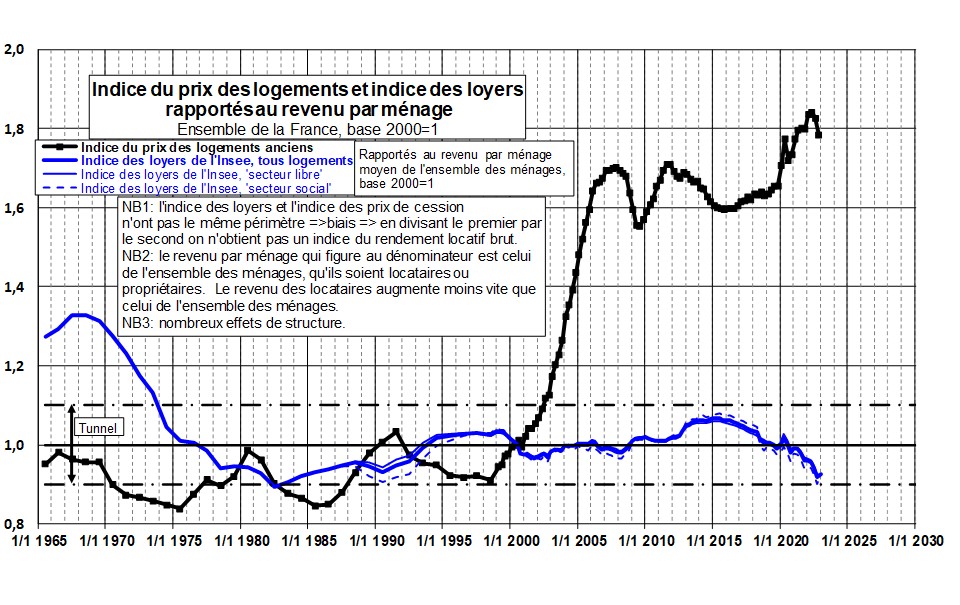
Housing, again is easy to disprove for the relevant timeframe - price to income ratios were not much higher than in the past before covid (after trump 1 and way after Reagan or Clinton). The size of the houses was steadily increasing too, indicating increased demand for bigger houses due to increased incomes and living standards. But the vibes among recent college grads wanting a house in SF specifically is certainly pretty gloomy.
The US are kind of an outlier because price recessed between the financial crisis and Covid, but it has then caught up with the broader western trend. And keep in mind that the “price to average income” ratio doesn't tell you anything about the situation of the lowest incomes, which have declined relatively to the mean.
> The size of the houses was steadily increasing too
Like with mobile phones or cars, a house twice as good and twice as expensive is still twice as expensive.
> indicating increased demand for bigger houses due to increased incomes and living standards
Unsubstantiated claim, and also wrongly assuming homogeneous growth of the house size (if 10% of your housing supply double in size, while the other stay still, the average size increase by more than 10% but this tells you nothing about the housing stock as a whole).
> But the vibes among recent college grads wanting a house in SF specifically is certainly pretty gloomy.
Not just SF, and not just recent college grads, that's the thing. Even social classes that used to be preserved from the housing cost increase are now affected as well.
Ratio was very similar in 1965 and 1995, for example and not much higher than previously after the housing bubble. So, not much to do with deregulation and welfare state in the 80ies or whatever.
Median house is not affected by average issues you indicate, and it increases steadily over time including when price to income is falling or staying low.
Also, since housing costs for most people are substantially affected by interest rates, the pre covid period would look even better.
Where is the data for the poorest, and what does the poorest mean, 1%, 10%, 0.1%?
Of course, housing prices, especially local, are mostly due to underbuilding, and underbuilding is to a large extent caused by zoning, and environmental/etc review. Nothing to do with "current system", unless by current system you mean too much government and too much democratic input over other people's property :)
"in reality welfare state with its massive redistribution and limits on concentration of power that won"
The welfare state increased 3x since post war time so that one is plain wrong. It was not clear if the 2nd part was "its" or separate . What is the metric for concentration of /power/? Rather than wealth. If anything the recent developments are the result of more direct democracy. Candidates like trump would have never been allowed by concentrated media and party machines mid century
Would be interesting to see the historical trends for operating margins.
These days it seems that 30%+ operating margins are what VCs and stock market are expecting now, which seems unsustainable. Software and similar businesses can easily do it because cost of manufacturing one more unit is close to zero, all the costs are primarily NRE. Not all business fit that model and but yet they all aspire to the same margins.
The odd thing is that in the US we we deliberately do not differentiate free speech from other things such as dollars, lies, propaganda and outright manipulation. This is a relatively new thing, forced upon us in the last few decades, and it is causing a spectacular crash in trust towards all our institutions.
But billionaires are making and keeping ever more money than before, so it isn't a problem.
This business is expensive, making and running fabs is way way more expensive than most anybody thinks. There are very few companies able to do it profitably.


reply