You can use the steering wheel and scroll up or down and you changed the temperature. No fooling around with touchscreen in traffic. It’s way better than any analog system I’ve used across Jeep’s and Audi’s.
You can control temperature, fan speed, brightness, and more all from the steering wheel.
Buttons are always in the same place, I know where they are, I don't have to go hunting for the thing that used to be there, but is now in a sub sub menu, meanwhile you aren't looking where you're going.
Geez people. It's NOT a submenu.. You just move the scroll-wheel up and down or push it to turn it on/off. It's that simple. It's also the default behavior.
> Taking your hands off the steering wheel involves...
Taking your hands off the steering wheel has never been a problem. Taking your eyes off the road is.
That being said, if you want to set a certain temperature with analog controls, you still need to look at the number (showing the degrees). Still, in other cars you can see that number all the time, you don't have to go into some menu. There is a dedicated physical button for that one function.
Maybe for that one example. In general a changing UI is not a good thing whilst trying to concentrate on other things. It isn't about hands on wheel, its about mental load, a hardware button is muscle memory, I don't have to look at it, I don't have think about it.
Ahhh backpedaling now are we? The topic was about A/C control... Hence that's the specific video proof I provided.
> It isn't about hands on wheel, its about mental load, a hardware button is muscle memory, I don't have to look at it, I don't have think about it.
reply
I don't have to look to use the scroll wheel controls too. Did you not see on the video that they are physical buttons? What's your point exactly?
> No you have to look at the screen, while you're trying to find the thing that was right there before the update.
Anecdotally speaking no... The item order have NOT changed from updates since 2012. I own the car and I am not speculating here. The UI change I mentioned was mainly aesthetic, similar to the iOS 6 to 7 color/look change.
I even said it should be the same even with the updates on my original post?
Give me physical buttons and knobs any day. I'm afraid with the direction that things are going, that may become more and more difficult, and go the way of crank windows and manual transmissions, however.
Oh well. The way that sticker prices keep going up on new pickup trucks, frankensteining old ones together and rebuilding the engines and transmissions is looking like more and more of a viable and cost-effective option.
You not only have to take a hand off the steering wheel, but also look to see which lever you want/need to press. If I'm changing the temperature I know where the dial is, but I also have to look to see what I'm setting it to.
I'm surprised people here think analog controls are a bulletproof solution to the same problems you're criticizing Tesla for. I have a hunch that if there were YouTube videos watching people change climate control settings in their car they'd not only be required to take hand off the wheel but also look down and away for a small period of time. Tesla's isn't perfect but you get to keep both hands on the steering wheel and head looking straight, but down ever so slightly.
We're criticizing bad UI design and the attitude that digital touch interface is automatically without fault and order of magnitudes superior to whatever was established in the last hundred years.
I don't know if anyone has said digital touch is superior, I don't think it is. It's just a different way of solving the same problem. Can it be updated in the future unlike analog? Yep. Can you feel it with your hands like you can with analog? Nope.
I feel like I see more people saying first that digital is terrible and it should be analog, that they'll never get a car that has digital. The reasons they list are still true for analog though.
It doesn't matter if they "say" it. They act like they do and it speaks just as much.
Everywhere I look (modulo self bias) I find people that are in awe of the digital touch interface. In contrast I don't find people in awe of analog buttons. They just use them and complain when they don't work for whatever reason. Digital interface touch "buttons" don't work on cars. We complain. It's simple.
Not really, it's a very old observation. For example, Cicero observed that "whoever gives his labor for money sells himself and puts himself in the rank of slaves"
And there are many types of slavery that are not chattel slavery.
> And there are many types of slavery that are not chattel slavery.
Exactly! The sort of slavery being referenced here is "wage slavery," and it derives straight from Cicero's line of thinking. The idea here is that the vast majority of humans in a developed economy need to work. In particular, people without the resources to start a business themselves have to work for someone else. Although there is theoretically a choice of employers (there may not in fact be due to locality of the labor market), one nonetheless has to work for someone else, selling their time. If one wants to survive, one is not free to leave one's job.
This lack of freedom is the essential notion of wage slavery. That some wage slaves are better off than others is irrelevant: house slaves in the American South were often treated better and had better working conditions than field hands, but they were still slaves.
So, people who both owned slaves and employed laborers, and were in a position to see the equivalence, but lacked the identity-group reasons either slaves or laborers would have to see an illusionary difference?
I’m having trouble parsing the second part of your response. Would you mind rephrasing it?
My point being that Cicero was free from a life of (physical) labor only because of the presence of these laborers/slaves. Property ownership enabled and paid for these intellectual or artistic pursuits.
I think the parent's response is clear, and that they should not rephrase it. In fact, I'm having trouble rephrasing it (without having to explain what "group identity" is).
Here it goes, nevertheless.
People are social beings. We like to find "our" groups, and feel pride in being members of them. Examples of such groups: political parties, nationalities, religion, fans of a particular kind of music/artist/clothing style/tv show, hobby groups, etc).
Because of that, we feel bad when our groups are conflated; we feel it erases a part of our identity. Waged workers in this example feel pride in being not slaves, however nominal the distinction is.
This effect is even more pronounced because in a stratified society (which the Roman Empire was), as a waged worker, you could be confused for a slave, but not for a member of nobility. (We feel the most animosity when being taken to be a member of a group that resembles ours the most. Tell a Ukrainian that culturally, very little differentiates them from a Russian - and be prepared to be lectured on just how wrong you are.)
So, waged workers, then and now, would have reasons to vehemently identify themselves as "not slaves", and thus they would be biased in assessing the differences, seeing all of them as significant.
Glassdoor is only useful when there are a significant amount of negative reviews for an employer. It means that the employer is bad, so bad that they don't care enough to pay a firm to pad their Glassdoor page with glowing reviews.
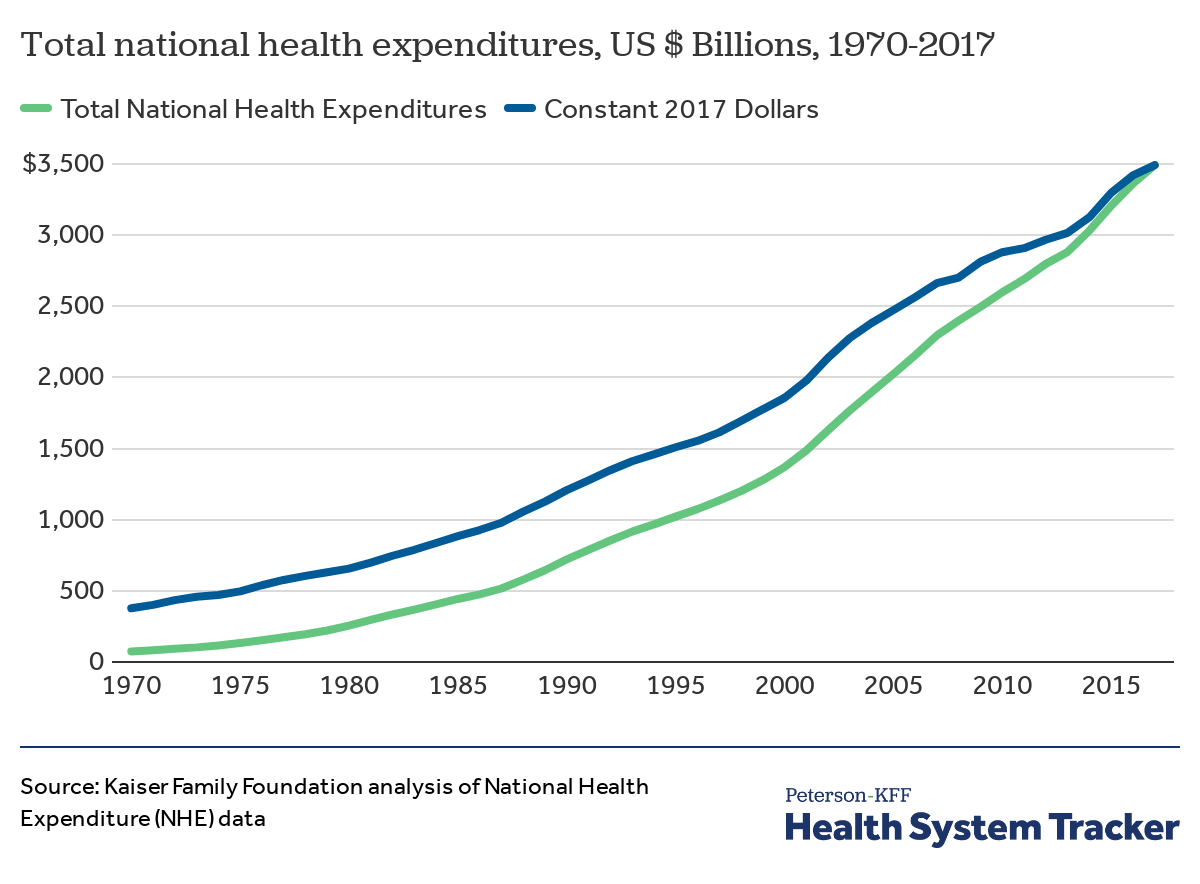
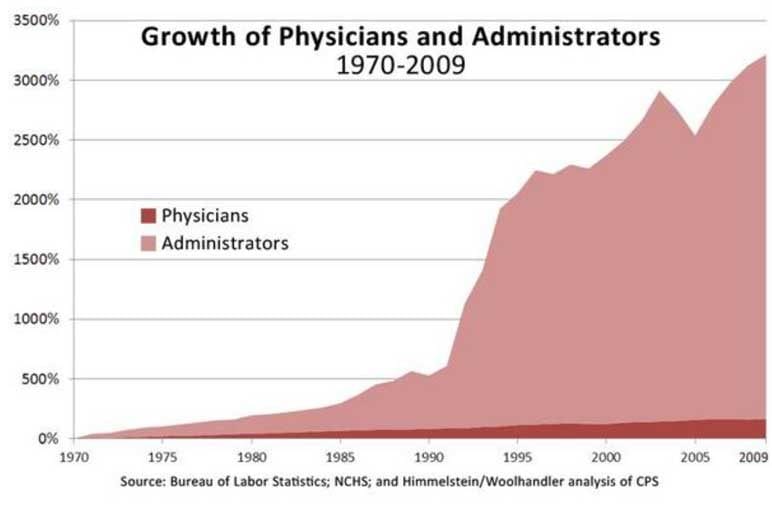
Total health expenditures have skyrocketed[1] along with the amount of hospital administrators[2] over the last few decades. This particular hospital is unlikely to have escaped the trend.
Uncheck the "latest data available" box to activate the range sliders and get a graph of costs over time.
Two things stand out in the graphs:
1. US is more expensive over the whole range of the data (1970 to 2018).
2. They are all going up, mostly at roughly comparable rates. I just looked at the G7 countries above, but the same holds for most OECD countries. It looks like the US has averaged going up a little more than many of the rest, but it looks like nearly everybody has got a problem in this area.
Event if the relative increases were the same, the absolute costs are on a different basis. US health expenditures per capita is double the average EU nation.
The worst is the blog spam that reaches the top of Google's search results.
I don't think it's a coincidence that those poor quality results are given precedence when they also happen to be littered with, and optimized for, Adsense ads.
Sounds more Kafkaesque to me, but the GP's comment brought to mind Autofac, a short story about an automated manufacturing and distribution system that continues producing and delivering product to humam settlements long after the apocalypse, while monopolizing resources, effectively preventing the humans from rebuilding.
I saw and didn't really care for the dramatization. Without giving too much away, they changed the ending significantly in a way that was particularly non-PKDian. The original has a strong theme of human struggle against a force that is vast, unstoppable, inhuman, and that gets lost in the adaptation.
Rich people can afford to insure and rebuild on disaster-prone, but otherwise highly desirable, property.
I lived near a barrier island that would get hit with hurricanes each season, and every 5-10 years a storm would devastate it. Despite that, property owners would rebuild their several million dollar vacation homes exactly where they last stood, but raised just a little higher than the last time.
I don't blame them, it's an amazing spot in the summer.
You don't believe Democrats because they compromised with Republicans to get a bill passed?
If you recall, Republicans used the filibuster in the Senate, which meant Democrats needed a 60 vote supermajority to get a healthcare bill passed. When they floated the idea of a Medicare-for-all bill, Republicans promised to filibuster in the Senate.
Democrats compromised with Republicans on policy that Republicans wrote themselves, and Republicans still filibustered and not a single one of them voted in favor of it.
If not a single Republican voted for it that means the bill is entirely the responsibility of the Democrats. It is a bill created and passed exclusively by Democrats. The Democrats passed a Republican plan without one Republican vote. The Democrats had a filibuster proof supermajority, and they decided to pass Mitt Romney's healthcare plan. But it's all the Republicans fault. Obama didn't even try for a public option like he had promised during the campaign.