Well, the increased variability itself may be a part of the climate change.
I’ll give an anecdote. I’m working on a project that tracks the length of the rainy season over time in a certain region. There is no clear trend one way or another, but what does stick out as a super strong and clear trend is that the variability of both extremes occurring is increasing.
> Of course, from a short-term timeline (say 100 years), the rate of species extinction from global warming will surely outpace the rate of species creation, since evolution has no time to act.
Which is really the only factor that matters here.
A large quantity of things will likely go extinct before being able to adapt or migrate sufficiently to keep up with the changes.
The re-development of biodiversity takes millions of years, and that’s basically irrelevant from the timescale of humanity.
Same here. I was a heavy smoker who struggled terribly to quit.
But once I quit, well, your “pay me to drink petrol” analogy is accurate. Its been this way for about 10 years now. I just don’t smoke, it’s now repulsive to me, and there’s almost no conceivable way for me to go back to it other than putting myself through the punishment of the early smoker again where it’s just disgusting and doesn’t feel good at all for several weeks.
Same here. I thought I had a good grasp on how I think and why I do what I do and this was a real eye opener. It was freaky that after 300 or so pages I suddenly didn't have to smoke whereas before I tried literally thousand+ times.
Wouldn't some weird interpretation of the Pareto Principle [0] mean that we should be using 20% of the available resources for 80% of our production goals?
We’re another level of the fractal of life, replicating patterns seen in bacterial biofilms, slime molds, circulatory systems, nervous systems, leaves, all manner of multicellular architectures.
It’s certainly a bad thing that we are growing in a sort of zero-sum manner against many original ecosystems though.
We need to learn to restrain our own growth (a tough one that we’re in the process of trying to beat into all of our heads it seems), and also we need to learn how to maximize the potential for biodiversity to exist within the structure of human occupied areas as well. (A good book on this last subject is “Win-win Ecology”).
The human footprint already covers nearly the entirety of the planet. Conservation of systems that are within or directly adjacent to that footprint is actually very important. Extraordinary amounts of biodiversity are contained in these areas and we need to study how to reconcile our land use with the needs of that biodiversity. We shouldn’t ignore it out of a fear that people will get the wrong idea.
Almost all (80-90%?) of the human footprint is making food. To try to grow our food and ensure biodiversity on the SAME LAND is going to be less productive per acre and would mean even MORE of the Earth’s surface is needed to feed humanity. That’s a losing proposition as we’re already near land usage limits in much of the world that uses less efficient production methods. The best way to ensure biodiversity is to INCREASE the intensity of farming, at the limit to just convert our staple food production to vat-based food production (think methane fermentation ala Calysta Feedkind, or maybe microalgae). Corn and wheat and meat gets highly processed anyway; you can hardly tell it WASNT made in a vat. Fresh fruit and veggies that retain their grown form are a relatively small part of our footprint.
Grow food in vats, and the vast majority of the planet can just be like National Parks.
But I do think we can think of smart ways to ensure biodiversity under, say, solar arrays. Solar arrays are (or can be made to be) biologically inert. If they are high enough, they can act as a sort of technological canopy over a biodiverse forest floor. And that would only be a small portion of the planet (the rest would be National Parks). We’d use solar electricity to produce food super efficiently from vats. About 2000-4000W nameplate solar per person (at least in the 30N to 30S latitude that most people live in) should be enough to provide the macronutrients for the average person. At high efficiency, that’s about 10 square meters per person at noon. That’s just 100,000 square kilometers to feed 10 billion people, compared to over 50,000,000 square kilometers used for agriculture today (which is half of the habitable land surface of ~100 million km^2). It can be over the ocean, too. That’s just 0.02% of the Earth’s surface.
I agree that we should ideally minimize our agricultural footprint and turn everything else into a nature reserve. But we’ve got to work from the realities of where we are today.
Notice that for the USA for example, not very much of the land is state or federal parks. The vast majority is used by humans in some way, and the reality is that they’re not about to turn it all into parks.
So, while pushing for the protection of as much land as possible, we should also study conservation on land that’s not already a protected area.
The book I mentioned has a number of examples where good conservation work has actually been done on such lands.
That “cow pasture/range” chunk is largely extremely low productivity scrub land owned by the federal government and leased basically for free by cattle folk. We could convert all of it to national parks without much more than a blip in food calories produced in the US.
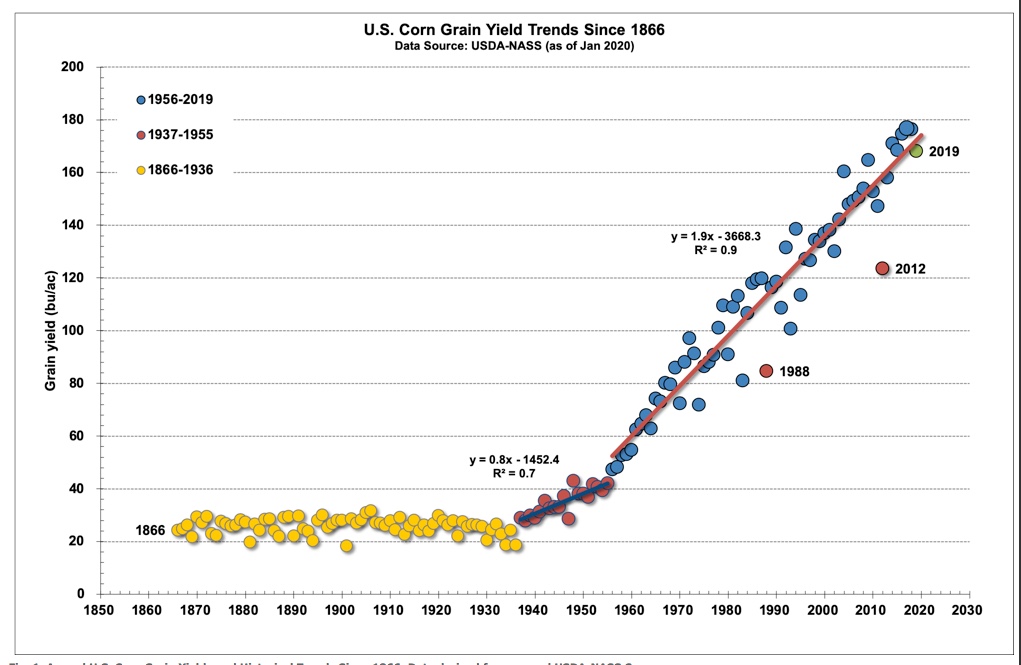
As far as actually farmed land, productivity has increased by an order of magnitude, MUCH faster than population, so we actually farm less land than in the 40s in spite of having a much larger population that eats more. We burn that corn in our cars, for goodness sake. The land area use for ethanol corn in our country is more than enough area to convert the entire nation’s electric production to solar.
> That “cow pasture/range” chunk is largely extremely low productivity scrub land owned by the federal government and leased basically for free by cattle folk. We could convert all of it to national parks without much more than a blip in food calories produced in the US.
Agreed!
I would emphasize restoration and protection in almost every case.
Just that there’s also ways we can work towards conservation on land that is being utilized too.
You talked about farms but there’s also: managed forests, anywhere anything is grazing, private lands, fisheries, artificial reefs and kelp forests, any area we already use which we can also stack on an incidental conservation benefit ontop of (as you mentioned renewable energy infrastructure will be a big one, the book I mention is full of other surprising examples such as military bases), things like wildlife underpasses, suburban lawns, and so on. This adds up to a lot of land.
I hope we protect half of the land and ocean like Edward O. Wilson and other major biologists recommend, but also I think it’s smart to look at everything and not just protected areas.
Yeah, military bases is definitely one area... I'm thinking of Cape Canaveral and Kennedy Space Center, which are both launchports AND nature reserves... and another one is nuclear power plants.
I hate mowing the lawn. I actually prefer the typical "weeds" like clover and dandelion over the typical grass. Dumb that we basically mandate weird, chemical and labor-intensive grass monoculture.
I actually think about 90% of the land ought to become basically national parks and/or protected wilderness. Maybe even more. We can live in dense cities in absolute luxury and abundance (with 10,000 square foot condos... why not? multiple stories make it possible) and then those of us who like to can go camping on the weekends. Traveling by electric motorgliders to our weekend campsite. Cars only underground (but everyone has one still).
Some of that cow pasture/range land used to be better land, and has been degraded by bad farming techniques and/or overgrazing. The area around Pipe Springs, Utah for example, was significantly more lush 150 years ago, and now it's scrub land. It would be a mistake to think of land as static and only fit for a limited set of purposes, and to therefore exploit it without concern for what it is or could turn into (for better or worse).
We're also causing top soil to erode and blow away in much of the corn belt [0]. That productivity has a cost and shouldn't be assumed.


I’ll give an anecdote. I’m working on a project that tracks the length of the rainy season over time in a certain region. There is no clear trend one way or another, but what does stick out as a super strong and clear trend is that the variability of both extremes occurring is increasing.