Flink is designed around streaming first, while Spark is built around batch first and you're likely best off selecting accordingly. Though any streaming application likely needs batch processing to some degree. Latency vs throughput.
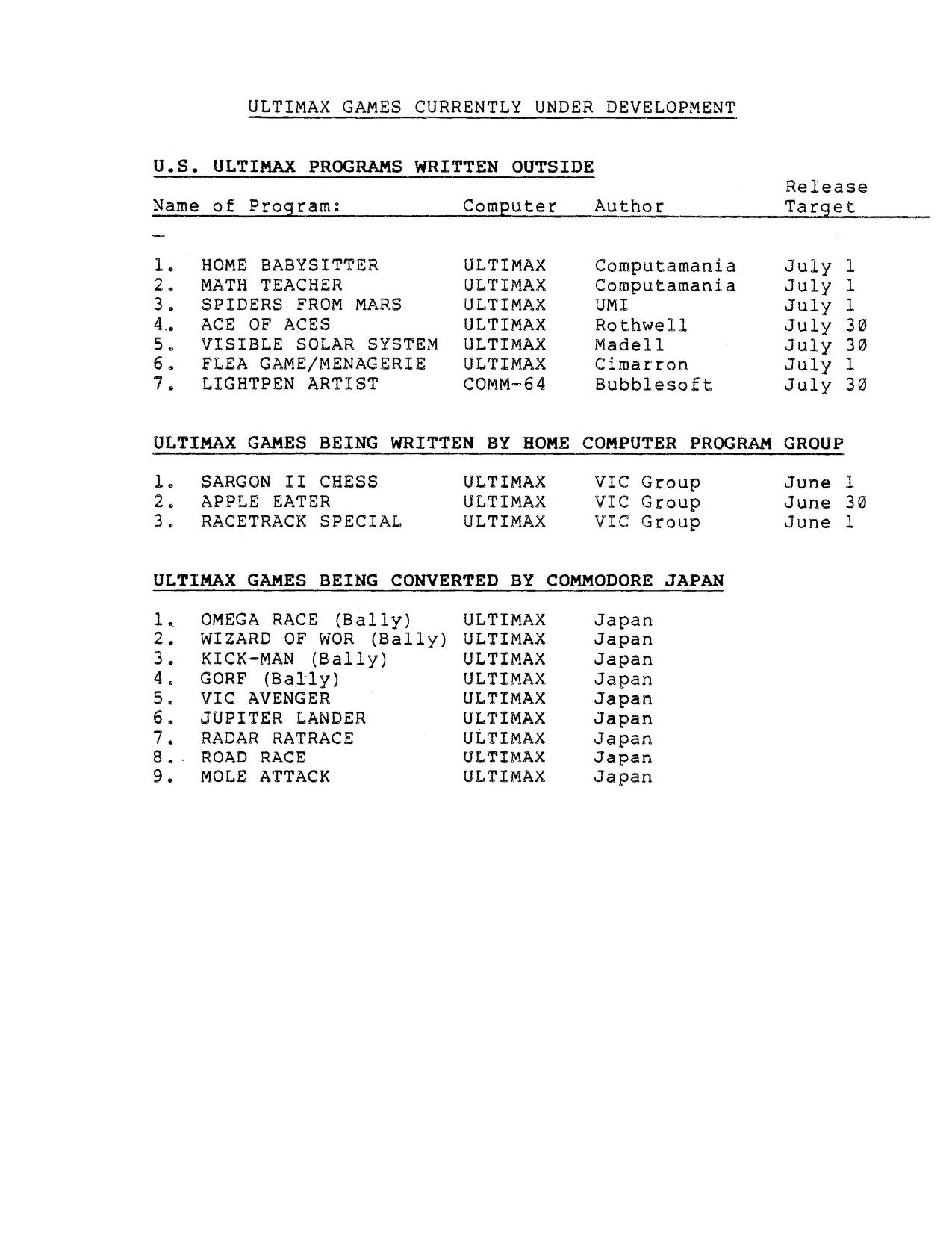
I don't know anything about the Ace of Aces pictured, but it's definitely not the Artech/Accolade one. $595 was the 1982 introductory price for the C64, so this pamphlet almost certainly dates from then.
I had considered that, but noticed the price and as classichasclass points out in a reply to me (https://news.ycombinator.com/item?id=43949843), $595 was the intro price. They're also comparing against the Atari 800 instead of the 800XL, so that's another piece of evidence. The 800XL was released in 1983.
“””
I remember clearly the day when the accountant showed me that we could effectively double our monthly sales and still not have enough to meet our eventual payroll obligations and that's about when you just finally sink into it: You're done.
“””
If you need your accountant to tell you this, you were doomed from the beginning.
Hasn't been my experience. I have recent 11-month and 7-month gaps and it hasn't been a problem. Additionally, I've switched companies a LOT during my career and I don't get asked about that very often. When I do, I just say "I kept getting offered better opportunities and more money" (100% true statement).
That usually ends that part of the conversation and we get onto something more relevant.
No other analysis I've seen anywhere of Thiel at the RNC takes into account this very, very important attempt at explaining Thiel's reasons:
"""
Now, in 2016, Thiel has finally found a politician capable of seizing that opportunity: a disruptor-in-chief who will destroy a dying system and build a better one in its place. Trump isn’t just a flamethrower for torching a rotten establishment, however – he’s the fulfillment of Thiel’s desire to build a successful political movement for less democracy.
"""
Thiel doesn't want less government, but he does want less democracy, because he can achieve his aims more easily if this is the case (or so he believes).
Lest anyone read the above and somehow believe I'm a Trump or Thiel supporter/advocate/etc, I'm solidly NOT.
From the man's own words, it seems to be a combination of:
• A shared feeling that America was once great, and it can be again, but currently is in decline. No other politician except Trump says this.
• Dislike of foreign wars, a feeling that only Trump says "end foreign wars" and really believes it.
And that's it. I'm not sure it really needs more analysis than that: Thiel feels America doesn't work as well as it used to, and like many libertarian types, is against foreign military intervention. If these two things are much more important to you than other things, it makes logical sense to support Trump.
Most Democrats say America was great once and can be again. They talk about the era of strong unions and manufacturing jobs as the golden age they want to return to. Big government spending too, which presumably means spending directly rather than just redistributing.
I understand trump over Clinton, but I don't understand why trump over Gary Johnson. He is a self proclaimed libertarian and the libertarian party is polling the highest in their history. Other than being anti war trump is the furthest from being a libertarian in Republican presidential history.
Because he can't win and people don't like throwing away their votes on ideology. First-past-the-post voting systems all but guarantee that when you vote for a third-party candidate, you're only really helping the first-party candidate most unlike the one you voted for (which is how we got Bush over Gore in 2000).
Some things in there that might turn someone who is typically Republican or conservative off of the Libertarian Party (and therefore the Libertarian Party's candidate):
• No restriction on abortion.
• Gets rid of foreign foreign economic and military aid (which I'm assuming would include getting rid of aid to Israel, which is why I think it would be a problem for Republicans).
• Calls for close to an open borders policy (exceptions being for people who pose a creditable threat to security, health, or property).
• Full legalization of most drugs.
Some things in there that might turn off someone who is typically a Democrat or liberal off include:
• Government should not discriminate on the basis of sex, wealth, ethnicity, creed, age, national origin, personal habits, political preference or sexual orientation, but private parties can. Those who disagree with a private party's choice to discriminate can respond with ostracism, boycotts, and other free-market solutions.
• No minimum wage.
• Implied elimination of public schools. (Education best provided by the free market, and government should not compete with private enterprise).
The snide answer would be America was "great back when it was okay to be racist, homophobic, and sexist." I think that characterization violates the principle of charity. People are upset about the decline of American exceptionalism. It's true that in the 60's we had all those bad things. But we were also indisputably the most prosperous and successful country on earth, with a broad and thriving middle class. People want that back.
And they aren't being offered what that from liberals. Democrats promise lots of free stuff from the government, paid for by taxing the rich more. Many people don't want that. They want the dignity of meaningful reasonably-paying work, not income redistribution. That's why they vote Republican (to the chagrin of Democrats who don't understand why they would vote against "their interests"). They believe that if we got rid of all these regulations and lowered taxes, jobs would come back and they could afford to be contributors to society instead of receiving benefits paid for by other people.
I was visiting my home town recently and ran into a former neighbor that is a Trump supporter. His answer for "great again" was that when he was younger his entire family had middle class incomes and nobody that he recalled received direct government assistance. Now, he says about a third of his family can't get by without help from the government and he sees the increasing dependence as bad for the family and for the country.
Exactly, but Trump has made no proposal that would actually accomplish that kind of "great again." He (and Thiel) are actually examples of the ultra-rich who are taking extreme profits at the expense of workers, so why would putting him in charge of the country make it any better?
Trump sort of has a gesture towards an answer, which is more or less: trade protectionism. The broad sketch of his argument is that free trade, or perhaps more specifically "bad trade deals", moved good blue-collar jobs overseas, and either ripping up the trade deals or renegotiating them will move the jobs back.
I personally am skeptical, but it's a pitch many people are open to. In my opinion protectionism isn't going to revive the American middle class and bring back millions of 1970s-type well-paying, unionized manufacturing jobs, because at this point it's difficult to create any kind of circumstances that will make that happen. Though I can believe a more historical version of the argument, that free-trade deals accelerated the decline of these jobs, which would've stuck around longer, rather than fleeing rapidly to Mexico and China, if we'd have had a more protectionist trade policy over the past few decades.
I can completely understand why people are willing to buy the argument though, in part because they're not being offered a particularly compelling alternative. Telling someone who used to have a good factory job and is now poor something like: "sorry buddy, these jobs are gone and not coming back, maybe go to university or sign up for welfare", isn't a big winner. But, I doubt this is what interests Thiel.
Seems like that is the kind of thing that gets you into trade wars. Not to mention that people would be Really Really Unhappy if iPhones suddenly doubled in price because of tariffs designed to protect American manufacturing.
But...I'm not an expert, so I don't know with any degree of confidence what the consequences would be. Problem is Trump's fans are so far down in the "not an expert" direction that Dunning-Kruger probably makes them think it really IS that easy...sigh...
Pretty sure I remember Apple saying it would cost a whopping $7 more per device to build an iPhone in the US. The real problem is that the US lacks a wealth of (low cost?) suppliers for the various parts in the phone itself, so it would be difficult to innovate at the pace Apple wants to move at.
(The example given IIRC was a change in the case or screws or something at the last moment demanded by S. Jobs that Apple believed couldn't be implemented quickly enough in the US.)
Problem is that the extreme rich (like Thiel) are the ones who are benefiting from the current situation, and deregulation/reduced taxation will just amplify the problem.
The core cause being that individual humans are much more productive now. We just don't need as many people working.
>They want the dignity of meaningful reasonably-paying work, not income redistribution.
About the only way to accomplish reasonably-paying work is to legislate it. WalMart employees make so little a substantial fraction (possibly 15% in one state) are on food stamps. [1] Minimum wage needs to be livable.
But as you push up minimum wage a lot of employers will cut back on how many people they hire. They certainly won't rehire the 5M+ people who have lost manufacturing jobs due to outsourcing and automation: Even the manufacturing jobs that are returning to the US are only hiring 1/10 or fewer the number of workers, and those need to be experts and managing robots. So if you have people who want jobs (and not, for instance, a guaranteed income), the government is going to need to be the employer of last resort. And I don't see Trump creating a New Deal.
The laughable situation is that Trump is known most for cheating companies and workers for his own benefit. He's in this for his ego and for selfish gains. Looking at the evidence, at best one can hope that Trump will break the country so badly that something better will rise from the ashes. And it's immoral to push for such a disaster for someone like Thiel who isn't likely to be one of the ones who suffer from the disaster. The ends don't justify the means.
It feels like they are hankering for a period of post-WWII prosperity caused by the decimation of the remainder of the developed world & great demand for American manufacturing, by a restricted labor market for women and minorities in higher end jobs and positions, and the need for lots of bodies in relatively high paying positions due to an absence of automation.
None of these things are coming back - I feel like they are yearning for a dream because they don't know why that dream existed.
Both fairly recent, high cost government driven projects. If you or supposedly libertarian Thiel think Republicans are the go-to party for infrastructure improvement, neither of you are paying attention.
But where's the evidence? The prognostications of a Guardian journalist is not evidence. Your last line is written as if it's a fact, but that's not even close to being a fact. Peter Thiel routinely gets backlash over his opinions, the man revels in it. Why would he suddenly start obfuscating his views now?
Over time I have become weary of people trying to explain voters preferences by asking "why are you voting this way", listening to the answer and then saying, "no, you're wrong. you're actually voting for that because X, Y, Z". How rude is that? People say what they want, they have no incentive to lie, and then they aren't believed?
We saw this a lot with the Brexit vote. Leave voters were asked by pollsters "why will you vote leave" and were told either "because I am tired of competing with low-wage immigrants for jobs" or "because I think the EU is flawed and cannot reform". Then a whole bunch of pundits started saying that no, it's actually not like that at all, it's actually a backlash against the elite, or racism, or whatever alternative explanation they preferred. But there was no evidence of this.
The same reason that websites/search-engines that rank what people are looking for do not ask for explicit feedback. When people give give explicit feedback they don't always give honest or accurate motivation for their preferences. Implicit feedback (observing behavior) works much better.
He wants to use the government's massive resources to carry out projects that he's aligned with -- perhaps even that he has control over.
...like every politician and lobbyist and capitalist, ever? How would that be a change of any sort? If this is how he thinks, why did he spend so much of his life dressing it up in "non-conformist" camouflage? He could have just said the same things that all "great leaders" do, and spared us the confusion.
Multi-lateral trade agreements running to thousands of pages that nobody reads, sweeping comprehensive legislation written by lobbyists also not read by the representatives voting on it (not even by the sponsoring representatives) with multiple attached amendments (often having no relationship to the underlying bill), legislation carefully crafted to give benefit to a tiny constituency (sometimes even a single individual), and the establishment's lackeys in the press call this "liberal democracy". This is more like government of the elitists, by the elitists, for the elitists. If it were to perish from the earth, what would replace it? This is panicking the establishment. (Not endorsing any particular alternative.)


https://ko-ko74.itch.io/balatro-for-the-commodore-64-c64